Allston Brighton Food Pantry, Brighton Farmers Market Return for Summer
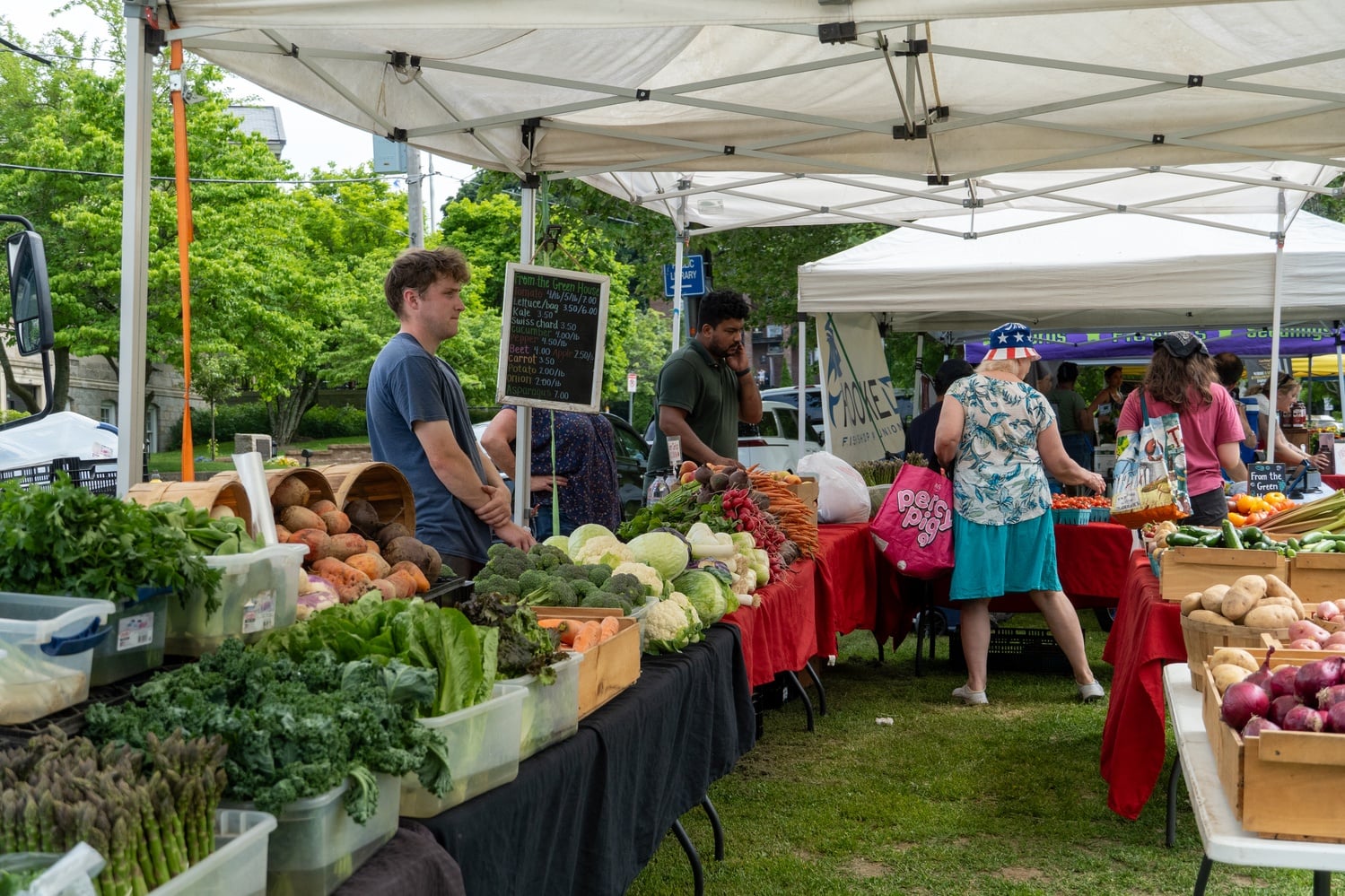
The Allston Brighton Food Pantry resumed full grocery distributions and the Brighton Farmers Market opened for the season last week, bringing back two neighborhood food access programs for the summer.
The farmers market — run by the Allston Brighton Health Collaborative — held the first of 21 weekly markets through October last Wednesday. The pantry resumed its biweekly Saturday distributions for the first time since the Brighton Allston Congregational Church, which houses the pantry, was forced to close in February after snowstorms caused extensive water damage to its roof and electrical systems.
Over the last three months, the pantry shifted to an outdoor distribution on Wednesdays and Fridays. But it had been unable to use food from the Greater Boston Food Bank because it could not meet some of the organization’s reporting and infrastructure requirements, according to Matthew R. Rasure, the pantry’s transitional director.
More than 100 people showed up to the pantry’s reopening, and about 60 percent of customers were repeat visitors, according to Rasure.
Residents who provide a name, address, and household size are eligible to receive food, including produce, grains, and canned items. Rasure said the pantry often attracts a “wide array” of residents because of its relatively low reporting requirements compared to other local options.
After the pantry closed, local food aid programs saw an uptick in demand and, at times, struggled to keep up.
“My heart has been broken for months as we have not been able to serve the community as we, as we normally have, and with the same kind of hospitality that we normally do, and so I am so happy to see to see this unfolding, and I know that our guests are,” Rasure said. “I know that our staff are really happy too.”
With the pantry’s reopening, the organization has also relaunched its Wednesday rescue groceries distribution and community meal, prepared by a chef using food that would have otherwise been thrown out by grocery stores. A thrift store that operates alongside the pantry has also resumed operations after several storage rooms were restored.
Rasure said the pantry has reduced its staff from 12 part-time employees to four full-time employees and one part-time chef, citing operational improvements and compensation equity. He will stay on until the church hires a new pastor, who will then oversee the pantry.
The rest of the pantry’s operations are supported by volunteers, including local student organizations.
Get The Crimson in your inbox.
“One of the saddest parts about our closure this spring is that we didn’t get to engage with the students during the semester in the way that we normally do,” Rasure said. “On any given Saturday, there would be 20 to 50 students from universities in the area.”
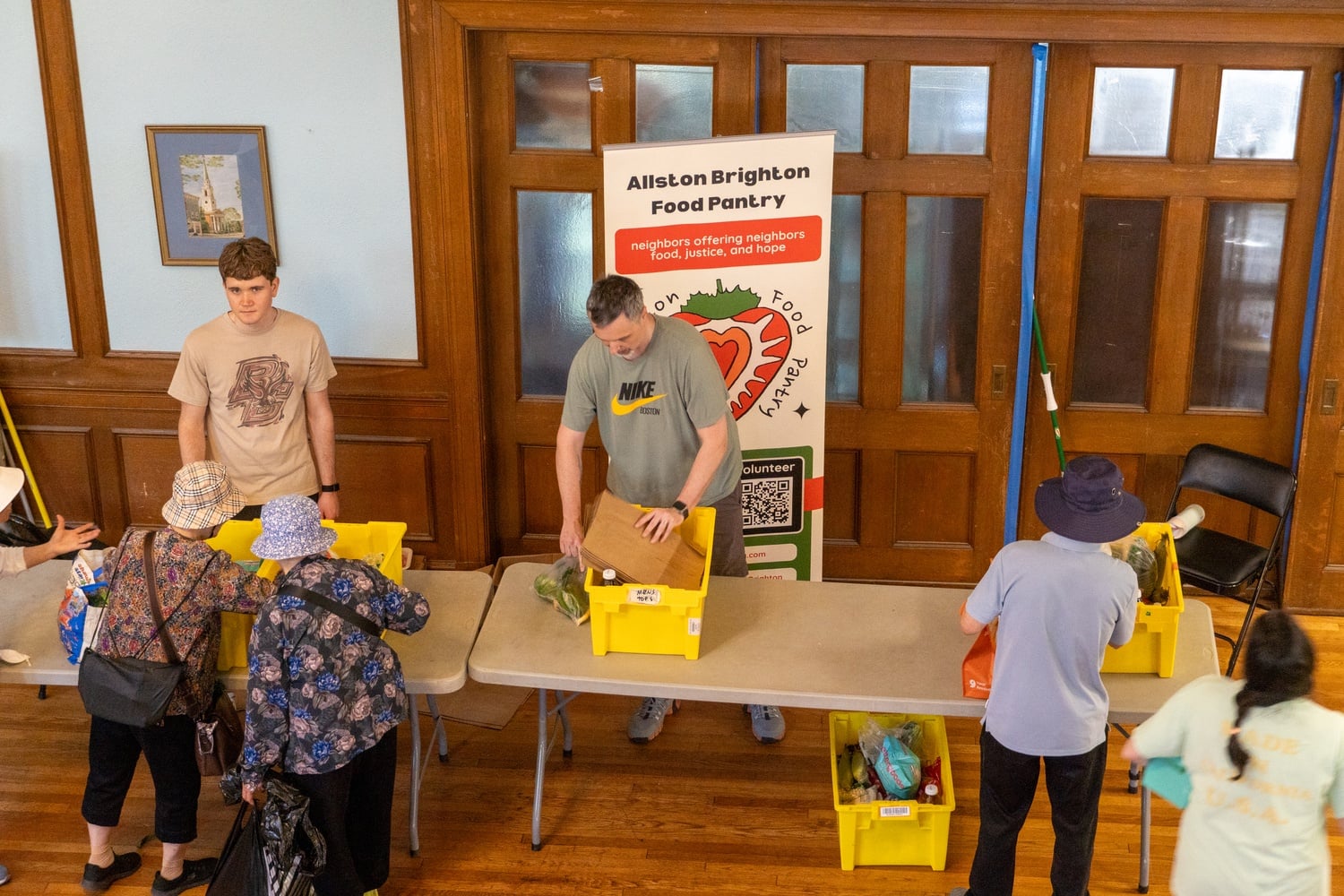
Rasure said the pantry’s reopening represents a “return to normalcy.”
“Allston Brighton is incredibly diverse, and it is one of the last places in Boston where lower-income folks can actually scrape by,” he said. “They are able to scrape by because of the food resources of the food pantry, of the thrift store, and to see folks coming back and gathering together just means so much.”
The food pantry is not the only program working to keep food within reach for Allston-Brighton residents. The Brighton Farmers Market accepts food benefits and subsidies, including SNAP and Healthy Incentives Program credits, and provides resources at a designated booth for the City of Boston’s coupon programs and the Senior Farmers Market Nutrition Program.
Bianca C. Bowman, the market coordinator for the Brighton Farmers Market, said the market’s mission is centered around food access. Local produce is hard to find in Allston-Brighton, she said, and the market gives residents a rare chance to buy it while supporting local farmers.
“It feels really special to be part of that legacy of trying to bring more fresh food to our neighborhood,” she said.
The market is still recovering from a short-term cut to HIP last season, which funded Massachusetts SNAP participants’ purchases of fresh produce. The restoration of the funds this year, Bowman said, created confusion for market patrons and shifted the market’s outreach toward local farms.
“We were hard hit last year, because people didn’t have as much funding to buy food, and that was tough,” Bowman said.
“I wanted to make sure we had plenty of farms here where people could actually use their HIP for fruits and vegetables,” she added.
Despite those setbacks, the market has added several new vendors this year.
Rebel Sprouts, one of the market’s newest vendors, uses vertical farming to reduce “food miles” between urban customers and its microgreen products. Maggie F. Pentzak, the company’s owner and founder, said she reached out to sell at the market because of its emphasis on locally grown produce.
“Those food miles, it racks up with transportation costs, the amount of chemicals you need to pump into the food just to be able to last that trip, you don’t have to do that,” she said. “It’s already locally grown right here in your backyard, which is really great.”
The market has also maintained some of its longstanding partnerships with farms in the area. Sayed Mohamed-Nour, the owner of Nubia Farms, a nonprofit urban agriculture farm based in Boston, has been a vendor at the market for the past 10 years.
“I love them,” he said of the market’s coordinators. “They work every single day.”
—Staff writer Theresa F. Bartelme can be reached at [email protected] and on Signal at theresabartelme.15. Follow her on X @theresabartelme.
—Staff writer Uy B. Pham can be reached at [email protected] or on Signal at ubp.88. Follow him on X @uybpham.
Want to keep up with breaking news? Subscribe to our email newsletter
Have a tip for The Crimson? Share it confidentially