For the Class of 2001, Summers’ Presidency Began With Both Buzz and Doubt
As Lawrence H. Summers waited to assume Harvard’s presidency, graduating seniors in the Class of 2001 saw both the promise of his power and early warnings of the turbulence to come.
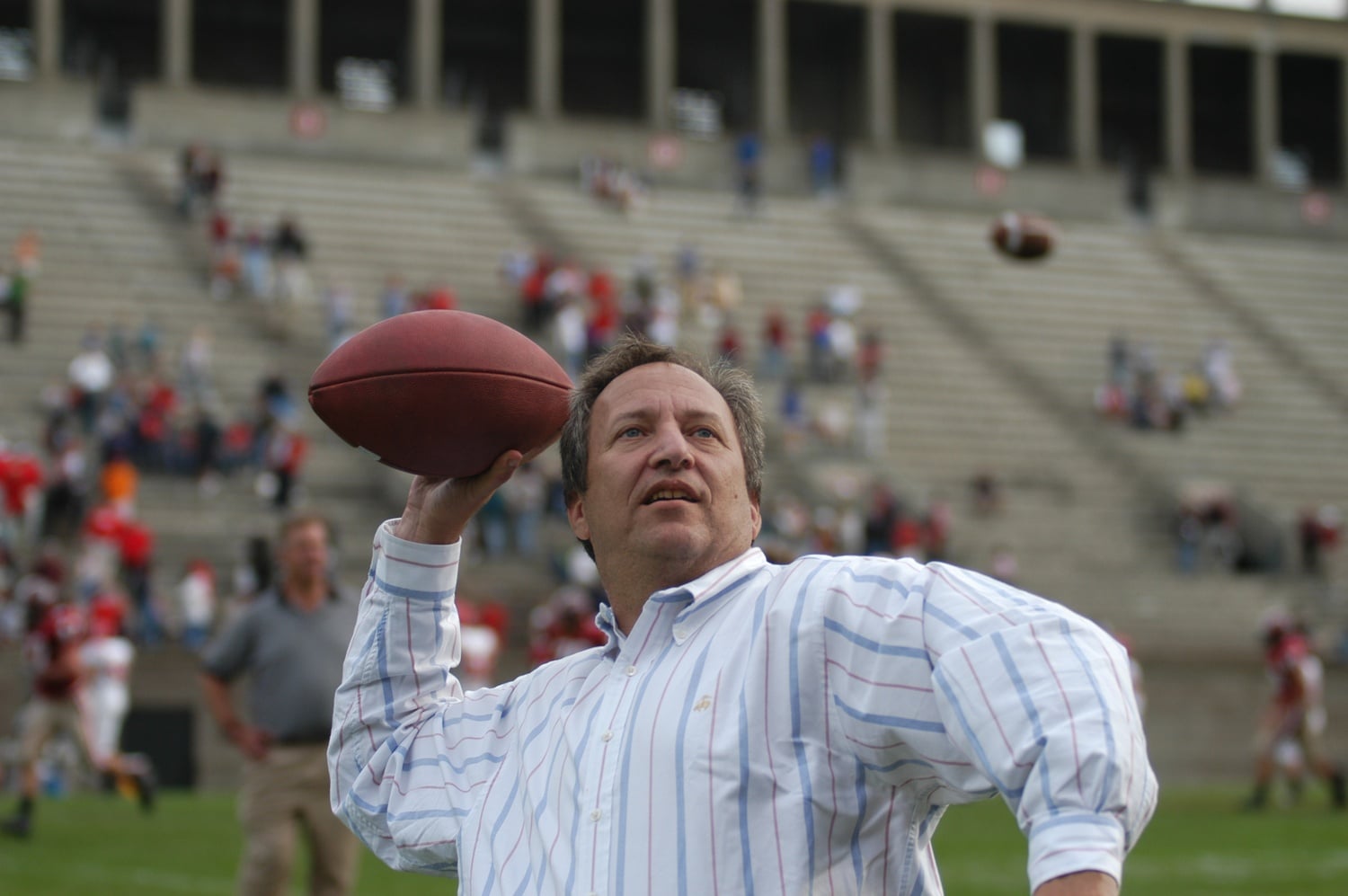
At Harvard’s 2001 Commencement, Lawrence H. Summers was still waiting for the job.
He sat alongside Harvard President Neil L. Rudenstine in Tercentenary Theatre as the Class of 2001 received diplomas bearing another president’s signature. But for many graduates, Summers — the former U.S. Treasury secretary, star economist, and President-elect — was already the figure to watch.
To some graduates, his return to Cambridge seemed to confirm Harvard’s place at the center of American power.
Steven J. Kruczek ’01 remembered Summers’ selection as an ego boost — a “look how cool we are, look how great we are” moment that affirmed Harvard as ”the pre-eminent place in the world right now.”
Even Bono, lead singer of rock band U2 and their class’s Class Day speaker, made it known that he was a fan of Summers — the “culturally challenged” economist who helped stir good will in Washington for Bono’s “Drop the Debt” campaign.
“Bono basically said, ‘Larry Summers is a nerd who didn’t know who U2 was, but he’s a really smart guy,” Jonas Peter Akins ’01 recalled.
Kruzek remembered the moment as almost surreal: Bono had come to campus through Jeffrey D. Sachs ’76, who had worked with Harvard’s incoming president.
“We were the center of the universe,” Kruczek said.
But to Akins and other graduates, Summers’ place at the “center of the universe” also made him a revealing, and risky, choice for the Harvard presidency.
Summers, they recalled 25 years later, looked like a splashy pick with the right resume but the wrong temperament for a job that required managing a broad, fractious, and self-consciously independent University.
Get The Crimson in your inbox.
“If you don’t appreciate that you’re going back to a very important educational institution — but educational institution nonetheless — I think the lack of self-awareness and, dare I say, ego could make it very difficult for your brilliance to shine through,” Akins said.
“This guy is really smart. This guy has been in positions of real power and authority, and may still lack the political savvy to occupy the corner office in Massachusetts Hall,” he added. “I think that was probably a good take.”
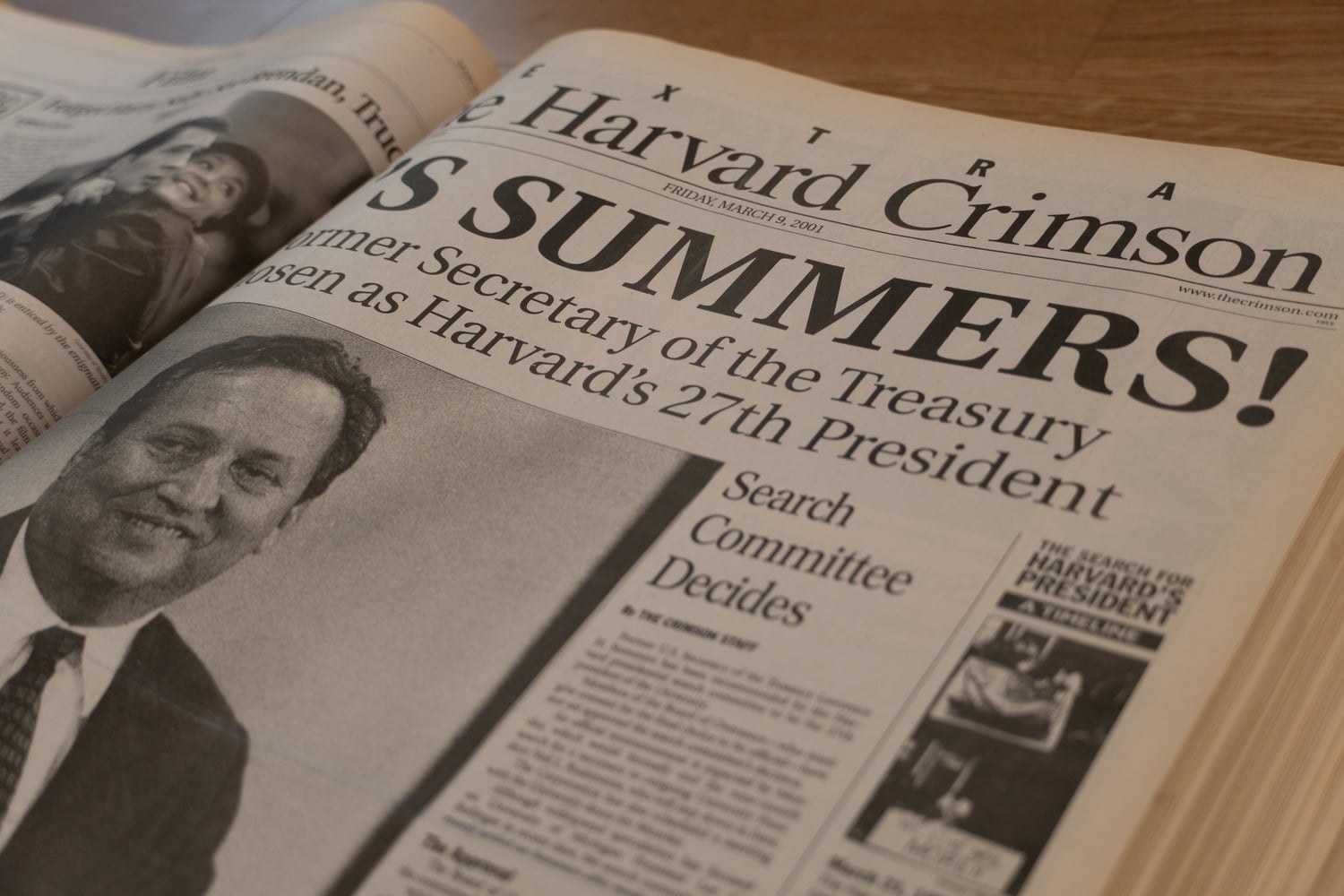
Summers went on to serve five turbulent years as Harvard president, advancing an ambitious agenda while drawing fierce opposition from faculty, students, and staff. By the time he gave up the job in 2006, Summers had become deeply unpopular among Harvard’s faculty — a standing worsened by remarks in which he appeared to suggest that women’s underrepresentation in science and engineering could be partly explained by “issues of intrinsic aptitude.”
Though he left Massachusetts Hall, Summers never fully left Harvard’s orbit. For nearly two decades, he remained a frequent and influential critic of Harvard’s administration, especially over Harvard’s tentative response to Hamas’ Oct. 7 attack on Israel.
Last fall, Summers faced renewed fallout after revelations that he maintained a cozy, decades-long relationship with convicted sex offender Jeffrey E. Epstein. In February, he announced that he would step down from his academic and faculty appointments at Harvard at the end of the academic year, relinquishing his University professorship.
In a statement, Summers wrote that he was “proud of what the university put in place” during his presidency. He cited expanded access to financial aid, Harvard’s launch into the Allston, broadened study abroad, a curricular review that would result in the revamped general education program, and the founding of the School of Engineering and Applied Sciences, among other initiatives.
“I’m also proud to have been the first Ivy League president in 30 years to attend an ROTC commissioning ceremony, to have condemned on-campus prejudice, including antisemitism, and to have highlighted issues relating to ideological diversity,” Summers wrote.
“Many disagreed with my vision. History will be the judge,” he added.
But all of that was still ahead of Summers in spring 2001 when the Harvard Corporation selected him over then-provost Harvey V. Fineberg ’76 and University of Michigan president Lee C. Bollinger for the No. 1 job in Massachusetts Hall.
For many seniors, the appointment barely registered. The decision to go with Summers in March was a “nothingburger” for many students, undergraduate council member Todd E. Plants ’01 said.
Akins said the presidential search seemed more exciting to Crimson reporters than to many members of the senior class.
He remembered thinking reporters “were very excited at the prospect of staking out meetings in Loeb House, coffees at The Charles, and dinners at the Four Seasons” but that the results of the search process had little bearing on seniors more worried about graduating and getting a job.
“It was echelons above reality for me,” he said. “The president occupied such a strange and distant role.”
Among students who followed the headlines, though, Summers’ reputation arrived before he did.
Peter D. Richards ’01 said he knew Summers as an “ego-driven guy coming from politics” when his appointment was announced and was “pretty bummed” by the choice. Though he said he was not deeply involved in campus politics, Richards said he was put off by the idea of “an egghead economist with his head in the sand” running the University.
“That big, ego mentality, I thought, didn’t jibe with the role as president,” Richards said.
Summers seemed aware that he needed to win over students. That spring, he made several early gestures of approachability, stopping by Lowell dining hall unannounced and making an unexpected appearance at Springfest, students said.
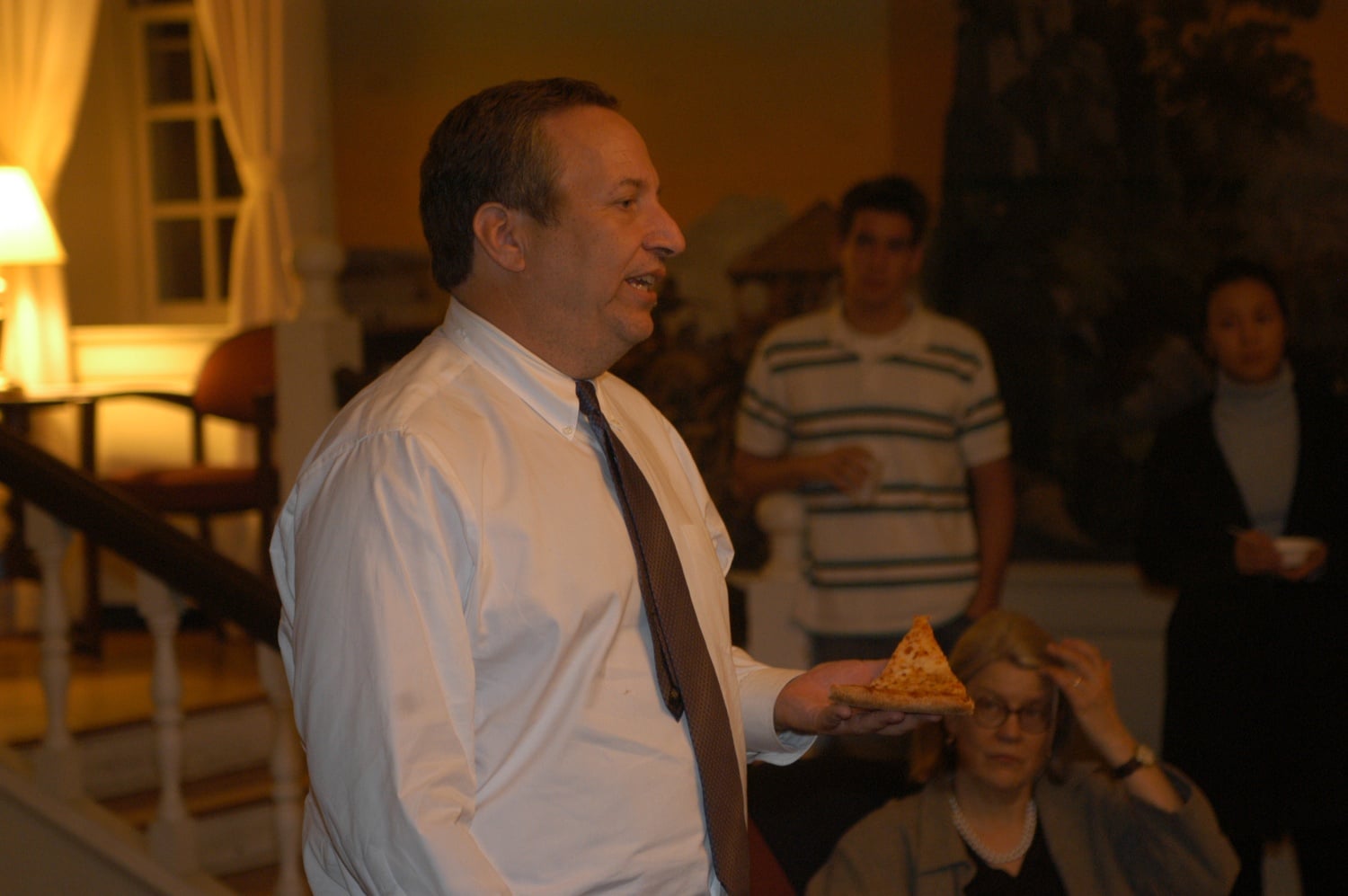
But while Summers’ accessibility to students would eventually become a hallmark of his tenure, the Class of 2001 said his initial outreach came across as par for the course for any new administrator.
Just hours after he was tapped as president in mid-March, for instance, Summers hosted a closed-door question-and-answer session with members of the Undergraduate Council at Loeb House.
Plants, who chaired the council’s Student Affairs Committee at the time, remembered the meeting as polite but pro forma — a “prototypical fireside chat.”
“At the time, it felt positive,” Plants said. “It felt like a chance to build connection with a new leader. I think in retrospect there wasn’t any big sea change developed out of it. There wasn’t any massive reconnection between the highest level of leadership and the students in the college.”
For Summers’ sharpest student critics, no show of good faith could overcome the circumstances of his selection.
Summers was appointed at the climax of the “Living Wage” campaign, a yearslong effort by the Progressive Student Labor Movement to improve pay for Harvard workers that culminated in a student occupation of Massachusetts Hall.
Two of the movement’s leaders, Amy C. Offner ’01 and Benjamin L. McKean ‘02, said Summers’ selection, and the closed search process that produced him, seemed designed to send a message to student activists.
“It was clear what message the Corporation wanted to send in selecting him — and it wasn’t to move the university in a more equitable direction,” McKean said.
The campaign had never been only about wages, McKean said. It was also about whether workers and students would be treated as meaningful members of the Harvard community.
“A big part of the living wage campaign, apart from the demand for a living wage, had also been for students and workers to be taken seriously as members of the community,” McKean said. “Larry Summers clearly was going to have no interest in that.”
The PSLM lobbied against Summers almost immediately. By late March 2001, they were distributing a 1991 memo signed by Summers where he appeared to endorse dumping the toxic waste of developed nations on other countries as economically sound. Summers has said the memo was sarcastic.
Not every student remembered the memo. But for those who did, it became an early shorthand for the kind of presidency they feared Summers would bring to Harvard.
“The ‘offloading the pollution onto African countries’ was a way of thinking about the world that just repelled me in a way,” Richards said. “You have to think that’s not going to trickle down very well into day-to-day decision making as a president.”
Darryl C. Li ‘01, who led the watchdog Harvard International Monitoring and Action Group as a senior, was even less sympathetic. He called the toxic waste memo “an early warning sign of a certain callousness and arrogance toward marginalized communities” from Summers.
Other graduates were more inclined to give Summers a chance to prove them wrong. Even Richards, who thought he was “probably more negative than my average friend,” said he was “willing to give him a shot.”
“I feel like he was saying the right things, by and large,” Richards said. “I don’t remember being like ‘This is total garbage and screw him.’”
His attitude, he said, was more cautious than fatalistic.
“My attitude was, ‘Let’s see what happens,” Richards recalled thinking. “I’m not happy about the pick, but there’s not a sense either at that time that you could screw things up super bad.”
—Staff writer Elise A. Spenner can be reached at [email protected] or on Signal at elisespenner.82. Follow her on X @EliseSpenner.
Want to keep up with breaking news? Subscribe to our email newsletter
Have a tip for The Crimson? Share it confidentially