Garber Says Tenure Is Needed to Protect Unpopular Speech in D.C. Remarks
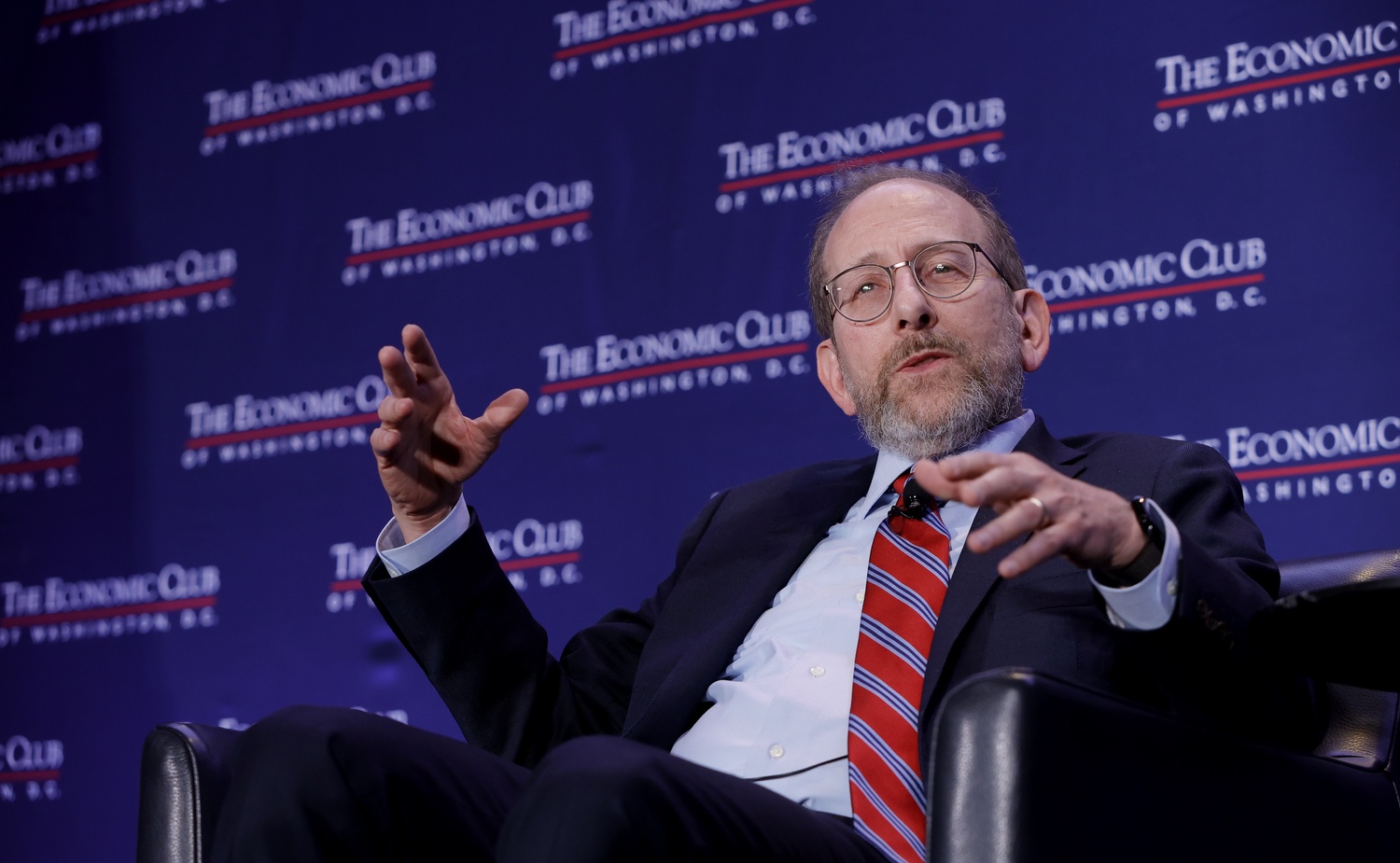
Harvard President Alan M. Garber ’76 argued Thursday that tenure protections were increasingly necessary to insulate faculty who could be targeted for unpopular speech, suggesting they served as a bulwark against political pressure.
Though Garber acknowledged that tenure protections were widely seen as little more than a “salary guarantee,” he defended the longstanding practice as a way to push back against rising intrusions on academic freedom.
“When you look around the country and you see some very well-publicized cases of attempted firings and firings of faculty, this issue about protecting speech of faculty has become more salient than it was five years ago,” Garber said during an appearance at the Economic Club of Washington D.C. Thursday afternoon.
His comments came in response to a question from former Harvard Corporation member and Carlyle Group founder David M. Rubenstein, who asked Garber to explain why the University could not simply “get rid of tenure and just treat academics like we treat other people.”
Garber’s answer was both academic and political. Recalling that the modern tenure system emerged in part from politically motivated firings during the early 1900s, Garber suggested that similar pressure threatened universities today.
“Tenure was created principally as a way to protect faculty who expressed politically unpopular opinions,” Garber said. “We should never forget that’s the reason it was created.”
Garber also offered an economic argument for tenure, pointing to the built-in incentive of job security.
“For people who value job security, they’ll accept lower payment in a tenure system than they would require if they did not have the job security,” he said.
At Harvard, tenure protections set a high bar for removing a faculty member. Under the University’s governing statutes, only the Harvard Corporation — the highest governing body — may remove a faculty member from an appointment, and only in cases of “grave misconduct or neglect of duty.”
Get The Crimson in your inbox.
Harvard revoked the tenure of former Harvard Business School Francesca Gino in May 2025 after nearly four years of dispute over allegations that she manipulated data in several papers about honesty. Gino has denied the allegations and is continuing to sue the University, arguing in part that Harvard’s disciplinary process violated her tenure protections.
The decision made Gino the first Harvard professor known to have lost tenure since the University formalized its tenure protections in the 1940s.
But at other universities, robust tenure protections are no longer a given. At least 11 states have introduced or enacted measures in recent years that could weaken tenure, including by subjecting public university faculty to more frequent reviews or making it easier to dismiss them.
The Trump administration has also made wide-ranging attempts to direct the governance and academic activities of universities around the country — and Harvard in particular.
In April 2025, the White House sent Harvard a set of demands that would have given the federal government unprecedented latitude to influence Harvard’s faculty hiring, admissions, and academic programs. Harvard rebuffed the administration and sued after the government froze billions of dollars in research funding. Harvard prevailed in federal district court last September, but the Trump administration appealed the ruling, and the case remains ongoing.
Even as it fights the White House, the University has shown it is responsive to political pushback. Under pressure over the overwhelmingly liberal makeup of its faculty, Harvard has made several efforts to broaden the intellectual scope of its ranks.
Over the past year, top administrators have socialized an effort to hire dozens of new faculty members in the name of “viewpoint diversity.” Some schools and departments have also separately pursued faculty searches intended to widen the range of scholarly perspectives represented on campus.
Harvard’s tenure review process has also attracted controversy of its own. The University’s process is notoriously opaque and grants top administrators wide latitude to reject cases without public explanation.
The President’s office has issued several controversial tenure denials under Garber. Most notably, Women and Gender Studies faculty member Durba Mitra was denied tenure at the final ad hoc review stage, prompting outcry from colleagues in her department.
—Staff writer Hugo C. Chiasson can be reached at [email protected] or on Signal at hcc.35. Follow him on X @HugoChiassonn.
—Staff writer Elise A. Spenner can be reached at [email protected] or on Signal at elisespenner.82. Follow her on X @EliseSpenner.
Want to keep up with breaking news? Subscribe to our email newsletter
Have a tip for The Crimson? Share it confidentially