Wu Says Boston Won’t Follow New York’s Lead in Restricting AI in Public Schools
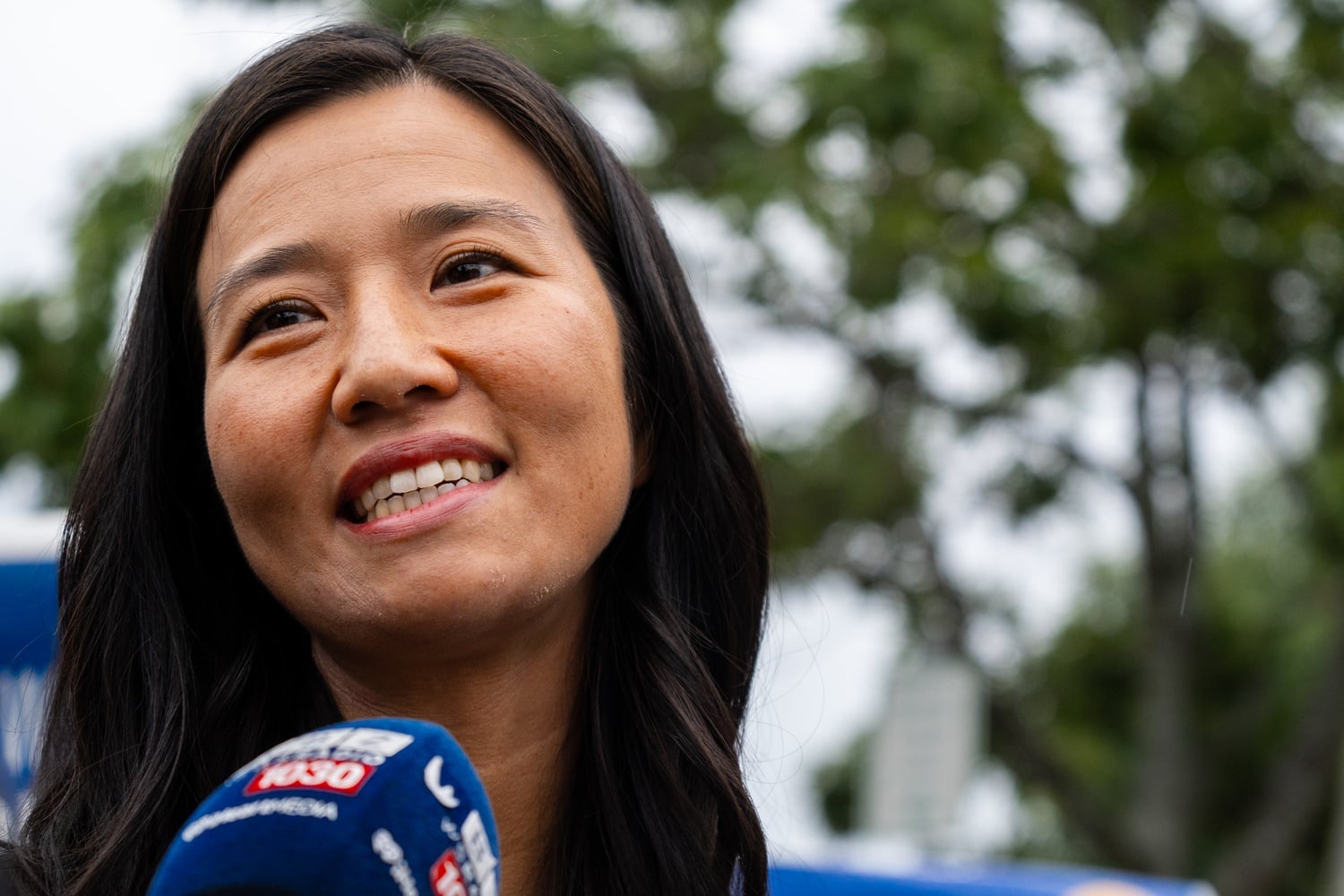
Boston Mayor Michelle Wu ’07 signaled Wednesday that the city will not follow New York City and other “peer cities” in pausing or restricting the use of artificial intelligence in Boston Public Schools, defending Boston’s push to teach students how to use the technology responsibly.
Speaking at an Institute of Politics forum, Wu was asked how she squares Boston’s plan to give every BPS graduate an AI curriculum with New York’s decision to bar younger students from using the technology in school.
“In recent weeks, we’ve seen other peer cities, New York, Los Angeles, etc., taking pauses or moratoriums, saying they want to figure things out of what the right policies should be,” Wu said. “I think in Boston we already have been putting in the time over many years, and with community partners and our ecosystem to have those conversations, to understand the details.”
Wu said Boston is already in the “implementation phase” of its approach to AI education. Drawing on her experience as a parent, she suggested that outright restrictions may be unrealistic as the technology becomes increasingly ubiquitous.
“I know as a mom, you can tell your kids not to do something and not to, you know, don’t watch TV,” she said. “You have to be realistic about certain things, and then empower the community to make responsible decisions that are in line with protections that are needed.”
Wu said the city has been working with the University of Massachusetts Boston AI Institute, tech entrepreneur Paul English, and members of the Massachusetts AI Coalition to shape its approach, building on Boston’s status as the first municipal government in the country to issue guidelines for responsible AI use by city employees.
“In our schools, the idea is that every single BPS graduate will have fluency,” Wu said. “They will know the types of tools that are available, the kinds of decision making that happens with that, and they will be also educated on risks, ethics, challenges, and be able to really promote responsible use in a safe and guided environment.”
The forum featured Wu in conversation with Whoop founder and chief executive officer Will L.F. Ahmed ’12, moderated by Harvard Business School professor Mitchell B. Weiss, a former chief of staff to late Boston Mayor Thomas M. Menino. The three discussed Boston’s innovation economy, AI, and the role of local universities in the region’s startup ecosystem.
Ahmed, who co-founded the wearable technology company Whoop as a Harvard undergraduate, used the forum to announce a new hiring initiative aimed at graduating seniors.
“We’re rolling out Whoop Pace Setters, which is a new program specifically designed for graduating seniors,” Ahmed said, adding that the incoming class would start next July. “No experience required. You have to be hardworking. You have to be competitive.”
Get The Crimson in your inbox.
Ahmed said Whoop started the year with roughly 750 to 800 full-time employees and plans to hire about 600 more by year’s end, growing its headcount by roughly 80 percent.
Much of the conversation centered on why Boston-area college graduates leave the region after graduation. Weiss cited a Pioneer Institute report finding that about 35 percent of the roughly 150,000 students who graduate in Greater Boston each year stay in Massachusetts. Wu pushed back on the framing that the city is “losing” talent, and pointed to the cost of housing and transportation as the central barriers keeping graduates from staying.
“The cost of living in general, but particularly the cost of housing, cost of childcare next in Massachusetts and in Boston, is the number one challenge that I hear,” Wu said.
Asked later about the federal government’s rollback of several routine childhood vaccine recommendations, Wu said the Boston Public Health Commission is working to keep residents informed and vaccinated despite the shifting federal guidance.
“The role of our Boston Public Health Commission, one of the oldest in the country, is to occupy this space between science and medical expertise, and community and our institutions,” Wu said. “We often are offering vaccination clinics. We are enforcing through our school system and other places the state guidelines.”
On transit, Wu touted the city’s recent success winning a permanent seat on the Massachusetts Bay Transportation Authority’s governing board.
“We lobbied hard for a law change, a state law change, so that we now have a seat on the MBTA board,” she said.
Ahmed, for his part, said he initially planned to move to New York after graduating in 2012 but stayed in Boston after discovering the Harvard Innovation Lab offered free office space to student startups. He said much of the advice he received early on — that Boston could not support a consumer brand or a serious algorithms company — turned out to be wrong.
“That was all BS,” Ahmed said. “It just wasn’t real.”
Asked to sum up why graduates should stay in Boston in five words, Wu offered a line playing on the city’s “You Can’t Beat Boston” branding.
“Home for everyone,” she said, before adding, “Won’t back down.”
—Staff writer Jen L. Phan can be reached at [email protected] and Signal at jenphan.74. Follow her on X at @jenllphan.
Want to keep up with breaking news? Subscribe to our email newsletter
Have a tip for The Crimson? Share it confidentially