Anthropic Chief Economist Says Company Is Exploring Ways to Steer AI Toward Augmenting Workers
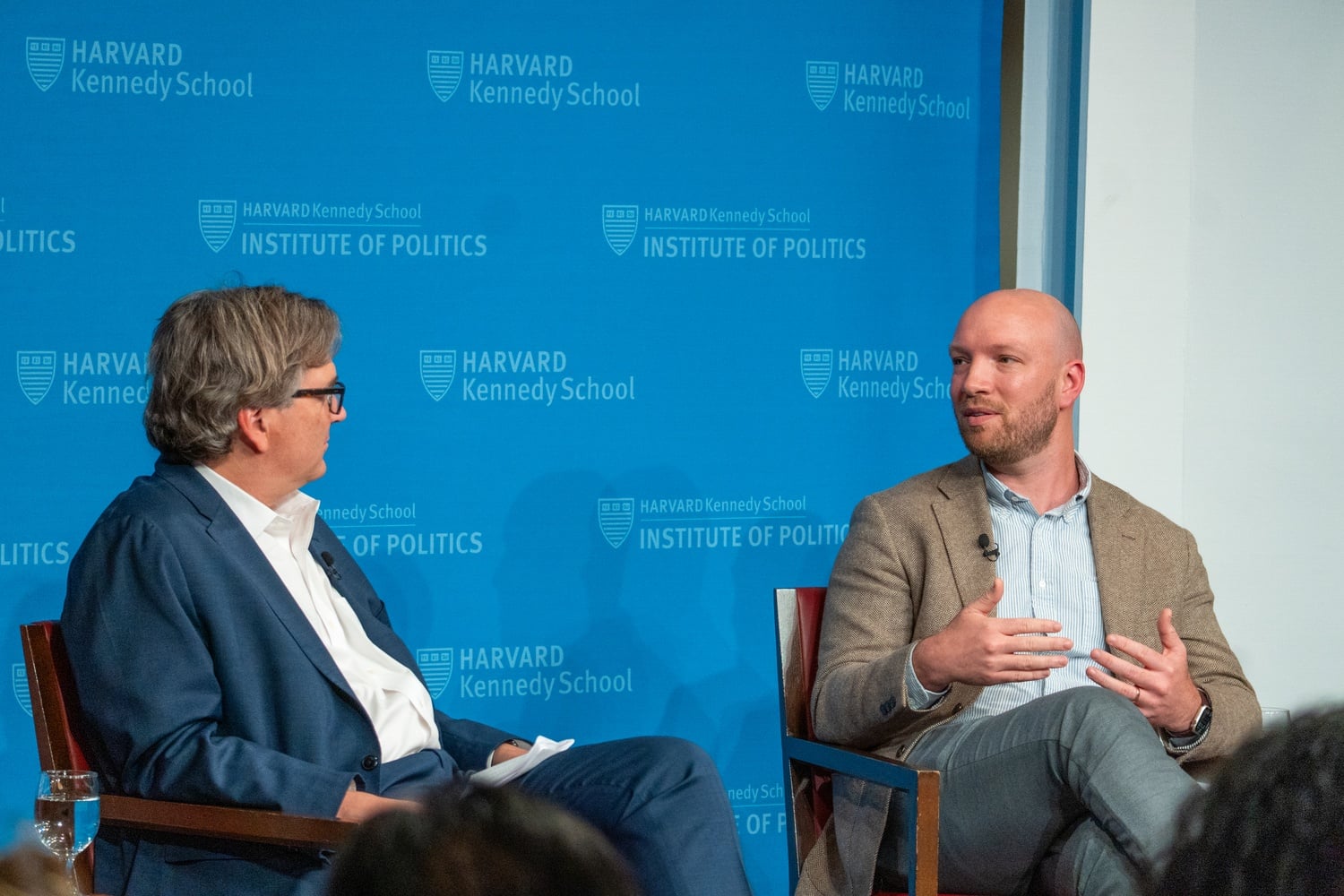
Anthropic’s Chief Economist Peter B. McCrory said Wednesday that his team is exploring whether the artificial intelligence company can steer its technology toward augmenting workers rather than replacing them.
Speaking at an Institute of Politics forum, McCrory said his team wants to test whether Anthropic can “operationalize directed technical change,” an economic concept holding that innovation can be deliberately channeled toward complementing labor instead of displacing it.
“I don’t actually know if it’s possible or not, but my team has an opportunity to see if it’s possible,” he said.
The forum was moderated by Economics professor Jason Furman ’92, who co-directs the Harvard Kennedy School’s Mossavar-Rahmani Center for Business and Government. The two discussed AI’s impact on the economy, Anthropic’s new projections for 2030, and whether the technology will widen inequality.
McCrory described the directed technical change work as part of a broader effort by his team to weigh the public costs of the company’s decisions against its commercial interests.
“I want to use the tools of economics to help Anthropic understand the impact of its own decisions, so that we can at least have a better handle on the public benefit versus commercial trade-offs that may be implicit in the decisions that we’re making,” McCrory said.
Furman asked McCrory whether an AI model that replaced his research assistant would count as augmentation or displacement. McCrory said the answer was both: the model would augment Furman’s work while displacing his assistant, an example of what he called the “uneven incidence” of AI’s effects.
Still, McCrory said his team’s research is meant to “empower society to make these choices that we shouldn’t be the ones to unilaterally make.”
Get The Crimson in your inbox.
Asked why AI has not proved a more significant factor in economic data, McCrory said the technology appears so far to complement skilled workers instead of eliminating jobs outright. He noted that no occupation has had every one of its tasks automated by Claude, Anthropic’s AI model, according to Department of Labor data.
McCrory said he expects AI to widen inequality between workers because the people adopting it tend to be higher earners.
“When you look at the data on who’s actually adopting, it looks more like, on the adoption margin, that it’s primarily adopted by higher-paid, higher-skilled people,” McCrory said. “Through that lens, I expect that it’s going to be inequality widening, as opposed to inequality compressing.”
During the question-and-answer session, a Harvard Law School student asked McCrory about the Feb. 28 U.S. missile strike on an elementary school in Minab, Iran, which killed more than 150 people, including at least 123 children.
More than 120 House Democrats asked the Pentagon whether AI was used to identify the school as a target, including the Palantir-built Maven Smart System, which reportedly incorporated Claude. Officials involved in an internal Pentagon investigation told Bloomberg last week that some personnel had relied too heavily on the system’s AI.
McCrory said he was not familiar with the details of the strike but that Anthropic takes the risks of the technology “seriously.”
“I’m going to try to do what I can on the economics side to help us navigate those risks and those benefits to ensure that the benefits are broad based, the risks are minimized and not unfairly borne,” he said.
Furman closed the forum by urging continued data collection and humility about forecasting.
“I hope when we bring you back, you can tell us which of your forecasts were wrong and why you were wrong,” he said. “Mine are wrong too. It’s part of what humility is and the error correction learning process.”
—Staff writer Uy B. Pham can be reached at [email protected] or on Signal at ubp.88. Follow him on X @uybpham.
Want to keep up with breaking news? Subscribe to our email newsletter
Have a tip for The Crimson? Share it confidentially