DOGE the HUA
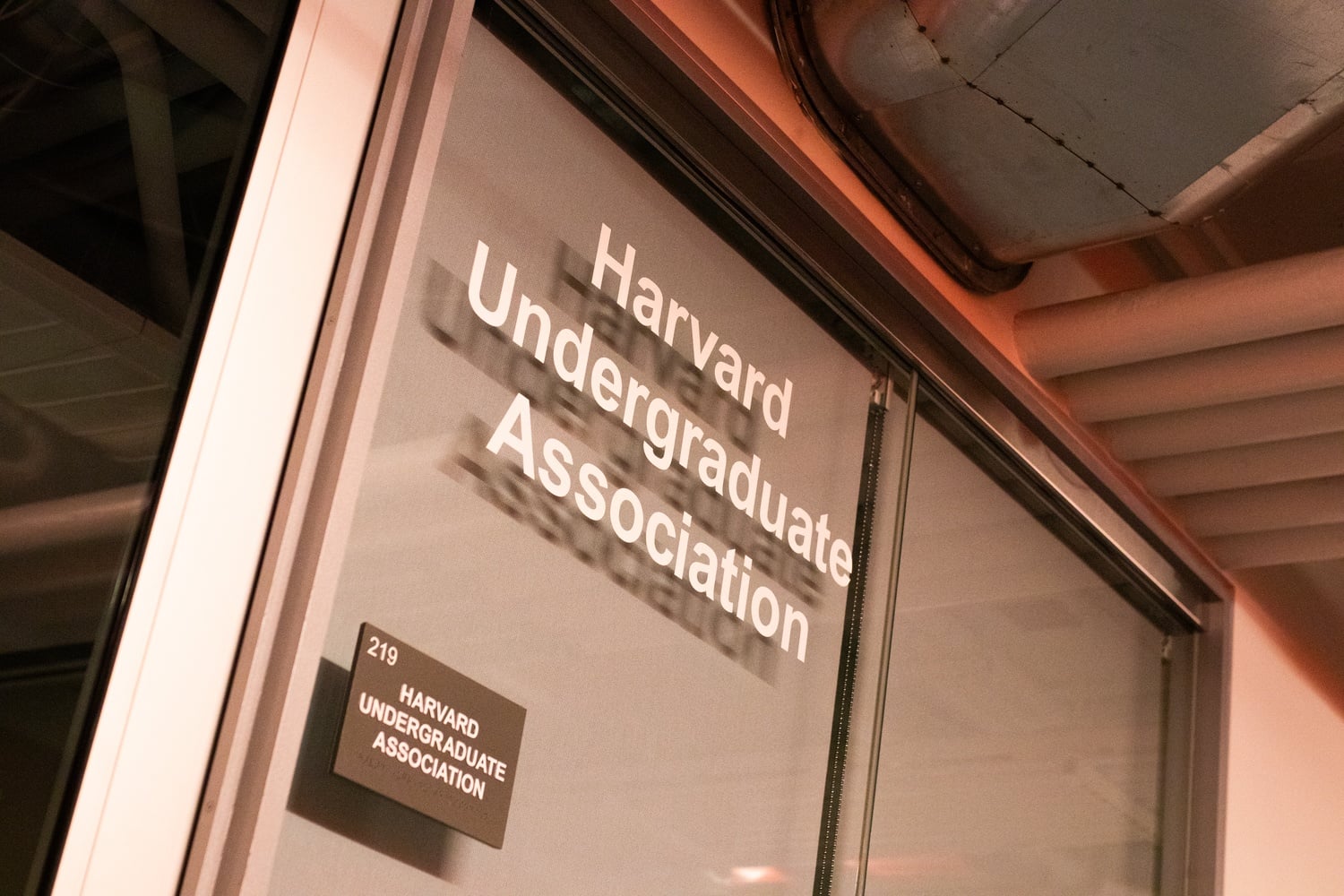
The Harvard Undergraduate Association’s meaningless bureaucracy is enough to make Kafka blush.
Like nearly any other candidates vying for the oh-so coveted seat of HUA co-president, current co-presidents Zachary “Zach” Berg ’28 and Daniel Zhao ’28 campaigned for student government leadership on a wide array of promises — from planning to raise $2.1 million for student organizations, to revamping events, to (most attainably) placing a student observer on the Harvard Corporation. Four months after their win, The Crimson’s headline read: “HUA Presidents Berg and Zhao Temper Campaign Ambitions.”
This should not be a surprise: Students at Harvard often overcommit. What should be a surprise, however, is that co-presidents Berg and Zhao recently unveiled the largest cabinet in HUA history, which includes vice presidents of technology, history, advocacy, and service.
Every last one is an empty suit.
The most flagrant is perhaps the vice presidency for history. History of what? A student government that has only existed for all of four years? At that point, why not hire a senior to reminisce on his time at the College? The effect would be the same.
The new resident historian himself (notably, a junior) affirms he will “accumulate some good resources” for administrative transitions. Besides the obvious non-answer of what “good resources” actually are (not semesterly financial reports or governing documents, since those are already publicly available), the HUA also already has a vehicle for institutional memory: Harvard and its administrators, who, by the organization’s own admission, work with the body.
At the very least, however, the historian is a single individual. Alas, the rest of the new cabinet members are a return to the HUA’s, and many Harvard organizations’, characteristic gluttony.
Take the HUA’s new vice presidents of service. The College already has a home for community service — the Phillips Brooks House Association, which hosts 86 programs serving more than 10,000 Massachusettsans. When did students demand: “We need the student government that cannot seem to accomplish its most fundamental function of club funding to coordinate service, too!”
Speaking of demands, there are vice presidents of advocacy. This is confounding. The HUA already touts that it interfaces with members of the University administration, and there is a diminished fundraising imperative this year because of the increased Student Activities Fee, so the HUA neither needs to do additional advocating to the administration nor to donors on students’ behalf. Above all, though, if the HUA needs to create a new position to do advocacy, what has the organization been doing all this time?
Finally, the crown jewels of the new additions are the vice presidents of Claude — sorry, of “technology.” The position’s express goal is teaching students how to use artificial intelligence tokens. Harvard students, famously, are unfamiliar with artificial intelligence, as is the administration actively antagonistic toward the technology (Harvard College Dean David J. Deming chief among them!).
Granted, Berg supplies an anecdote as evidence of this role’s mandate: At an HUA general meeting (with a remarkable 40 students present), when asked if they were aware of Harvard’s new AI credit system, “fewer than half of the students in the room did.” Oh well, at least these 20 or so students and their similarly ignorant peers will now have access to information about how to use artificial intelligence that is otherwise not accessible anywhere, in any form, certainly not on the internet, and certainly not able to be explained by one individual rather than two.
The HUA only got here because we, the students, allowed it to. In voting for a pair of presidents who ran on a platform of New Deal-esque expansionism, students gave the HUA a carte blanche for its newest scheme of pointless appointments.
The HUA must commit itself to a far narrower program — one that has appeared in the pages of The Crimson as recently as last spring — whereby the organization functions purely to fund other student organizations and advocate on behalf of students to the administration. Such an ambit certainly does not require 18 officers. But this will not happen until we students put in office someone who campaigns not with hopelessly grand plans, but instead for an HUA that exists in its correctly narrow role.
In his “Discorsi,” Niccolò Machiavelli juxtaposes the republic (Sparta) and the great republic (Rome) using the analogy of a tree. The latter, Machiavelli argues, is capable of expanding because it has a robust base, because it seamlessly incorporates its newest elements into itself, just as a tree with a strong trunk can support manifold branches. The former, meanwhile, cannot grow because its trunk is so weak that the weight of the new branches will cause things to snap.
That day is coming soon for the Sparta-like HUA — a body that, without any ability to perform its foundational task, continues to grow. For now, however, the only thing that has certainly snapped is this writer.
Jackson H. Barr ’29, a Crimson Editorial editor, lives in Leverett House.
Want to keep up with breaking news? Subscribe to our email newsletter
Have a tip for The Crimson? Share it confidentially