Harvard’s First-Year Advising Overhaul Faces an Uneven Rollout
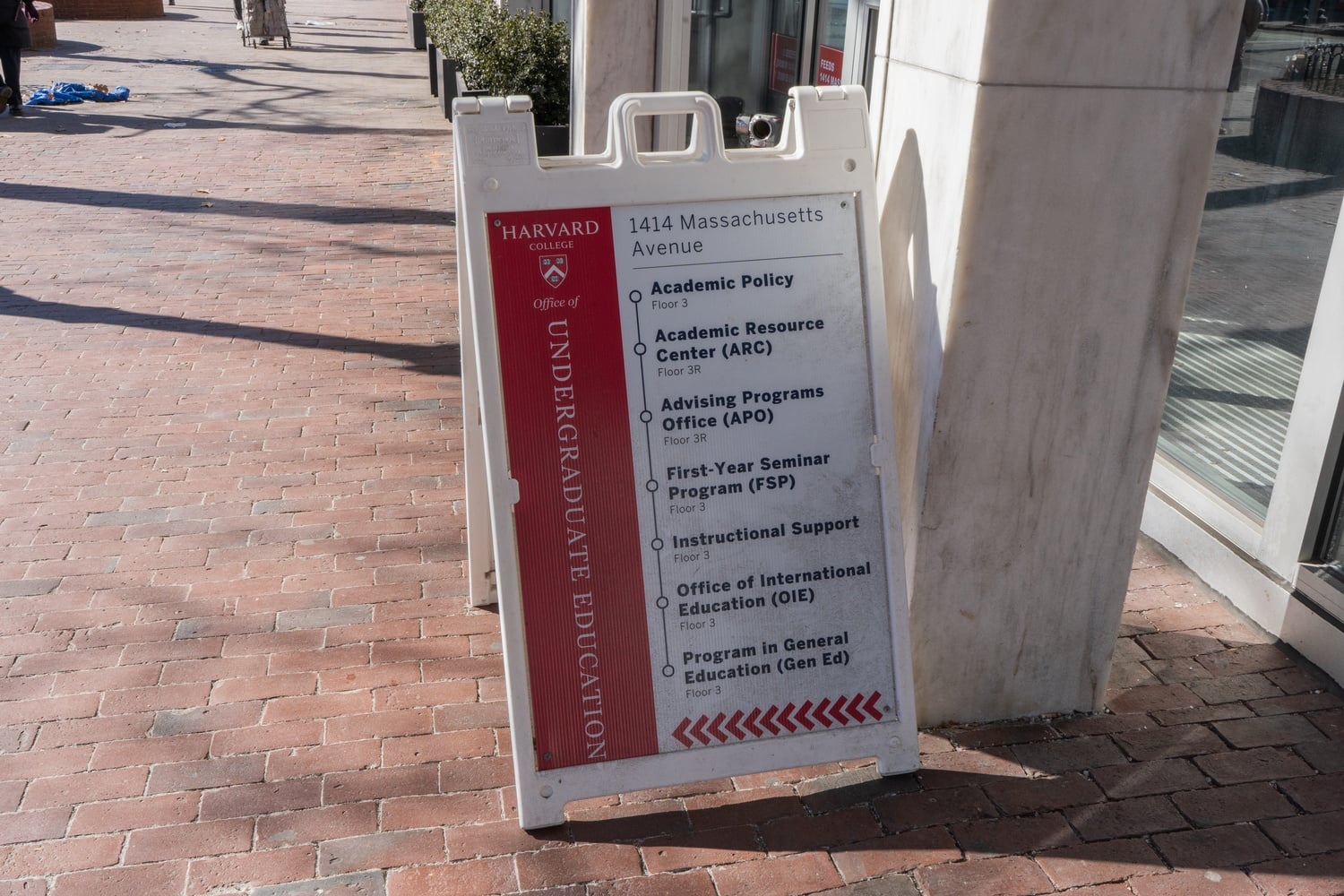
Harvard’s overhauled first-year advising system is entering the fall semester still a work in progress, months after the College eliminated individual pre-concentration advisers and shifted freshman toward group sessions, peer advisers, and departmental support.
Harvard College Dean David J. Deming told Peer Advising Fellows during a training session in late August that the advising overhaul was “halfway at best” complete and that the College still had some “things to work out,” according to four students in attendance.
“We’re kind of halfway at best through it right now,” Deming said.
Deming said he wished the broader Faculty of Arts and Sciences restructuring, which eliminated 165 staff positions this summer, had happened earlier to give administrators more time to settle the new system.
“It would have been great to have done that a few months in advance, so we had more time. We have some things to work out here,” Deming said.
Dean of Undergraduate J. Claybaugh similarly acknowledged that the summer’s “rolling layoffs” limited the College’s ability to build new advising programming, particularly in collaboration with academic departments.
“Our ability to stand up new programming, particularly in collaboration with the academic departments, was not everything we would have wanted,” Claybaugh told PAFs during the training session, according to a recording of the training obtained by The Crimson.
The new model reflects a broader shift in the College’s advising philosophy. Deming told PAFs that Harvard is trying to “professionalize” the parts of advising that require specific academic expertise while “intentionally deprofessionalizing” aspects centered on mentorship.
Under that approach, students with technical questions about courses or concentrations are increasingly expected to turn directly to faculty and departmental directors of undergraduate studies. PAFs and proctors, meanwhile, are expected to focus more heavily on helping freshmen build relationships.
In an interview with The Crimson, Deming said that despite the administrative changes, the College still intends to provide students with the same level of advising support.
Get The Crimson in your inbox.
“From a student’s perspective, they want to know: Can they get the support they need? And I think the answer to that is yes,” Deming said.
The shift follows the College’s decision in April to phase out pre-concentration advisers, eliminating the individual academic adviser assigned to freshman and sophomore before they declare concentrations.
Under the replacement model, incoming students complete online modules and small-group advising sessions before arriving on campus and are then directed toward PAFs, proctors, faculty, and academic departments.
Claybaugh told PAFs that she did not expect eliminating PCAs to have “much of an impact” because, in her view, the previous system was “not actually working,” Though she expressed gratitude for the advisers who served in the role, Claybaugh said student surveys showed that some freshmen did not know who their PCA was and that advisers often had to redirect students to faculty for specialized academic questions.
“I don’t think it was having much of an impact. So I don’t think the absence of it will,” Claybaugh said.
In an interview, Claybaugh said she hopes the new structure will push students to develop relationships with faculty and learn how to “build the network” of support, rather than funnel all their questions through one assigned adviser.
“I hope that students don’t experience it as us taking away a resource,” Claybaugh said. “It’s actually us modeling for them and structuring for them an experience of seeking information and guidance and building relationships.”
But some incoming freshmen and PAFs said the transition has left them unsure about where to seek academic guidance.
Chloe J. Ryan ’30 said that there was a “lack of communication” over the summer about who freshmen should approach with questions.
“I know I have a proctor and a PAF, but — besides the initial email — there weren’t really a lot of next steps on what you should do or who you should be talking to about this,” Ryan said.
PAFs also said they are already fielding more academic questions under the new structure, even as they are instructed to redirect highly specific questions to faculty and departments.
“I’m the only 1:1 connection they have,” wrote Tess E. Sumner ’29, a PAF for Lionel Hall. “Which means I have more responsibility.”
“I’m getting a lot more academic questions that I don’t always know how to answer, and I have to send them back to Harvard’s website,” added Sumner, a Crimson News editor.
Frederick L. Klein ’28, a PAF for Wigglesworth Hall, said proctors also may not have the subject-matter expertise to answer detailed academic questions.
“I think proctors actually do a good job, but I am worried about the question of capacity and subject matter expertise for proctors,” Klein said. “Not every proctor is going to know everything about everything, versus an adviser is someone that is especially trained to help someone in an academic journey.”
The College’s small-group advising sessions, held throughout July, were another major component of the system. Roughly 30 incoming students were placed in 75-minute virtual meetings, where PAF facilitators were instructed not to answer “highly specific questions,” according to a guide given to the session facilitators. Instead, the guide instructed facilitators to direct students to faculty and departments.
“This workshop is intentionally not designed as an individual source-advising session,” the guide read.
Several incoming freshmen said the sessions were useless for meeting classmates but fell short of the individualized academic guidance they expected.
Kris N. Lau ’30 said the session did not explain basic logistics such as navigating my.Harvard or selecting courses.
“It never really talked about how to navigate my Harvard, how to use the course selection, or talked about any specifics,” he said.
PAFs also said that sessions were not designed to replace individual academic advising.
“It did feel more like a Canvas module than an advising conversation because most of the questions were reflection questions,” said Ian Toyota ’27, a PAF for Wigglesworth.
Deming said the College expects to continue adjusting the advising structure as the year unfolds — and acknowledged that the success of the overhaul will ultimately depend on students’ experience with it.
Asked about concerns that the summer restructuring could diminish the student experience, Deming said he believed it would not.
“But the proof is in the pudding,” Deming said. “If things aren’t working and we need to course correct, we’ll do it.”
—Staff writer Megan L. Blonigen can be reached at [email protected] and on Signal at mblon.50. Follow her on X at @MeganBlonigen.
—Staff writer Alexa M. Schmitt can be reached at [email protected] or Signal at alexaschmitt.15. Follow her on X @alexa_m15_s.
Want to keep up with breaking news? Subscribe to our email newsletter
Have a tip for The Crimson? Share it confidentially