‘On Location: Drawing the Outdoors’: Harvard Art Museums Features the Natural World in Their New Exhibit
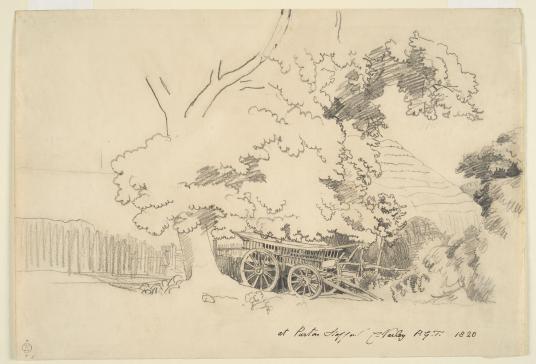
Harvard Art Museum’s new exhibition, “On Location: Drawing the Outdoors,” seeks to educate viewers on the richly complex tradition of 19th century European landscape drawing. Located in the museum’s Special Exhibition Gallery, “On Location” features 137 works of landscape art from all across the European continent, including the United Kingdom, France, and Germany. The exhibition is the culmination of years of work spearheaded by Joachim Homann, Maida and George Abrams Curator of Drawings.
“I saw all the works that I was looking at for so long and works that I chose actually hanging there, and it was quite surreal,” said Kacper S. Koleda in an interview with the Crimson, a Harvard PhD candidate and a member of the “On Location” curatorial team, reflecting on the experience of viewing the final exhibition.
Homann drew inspiration for the exhibition from the historical importance of landscape art.
“It is a very important moment in the development of European art towards art as a personal expression and art as an opportunity for viewers to find a freedom of reflection and a space for them to discover something about themselves,” Homann said in an interview with the Crimson.
All 137 works are organized into 10 trails: categorical groupings that unite various works around a common theme. These trails serve as an homage to French philosopher Jean-Jaques Rousseau, who is highlighted in a special section of the exhibition.
“As anybody would guess when you talk about nature in Europe, at this time, Jean-Jacques Rousseau is the major figure, and his ‘Reveries of the Solitary Walker,’ — this book that has inspired me and the student curators throughout — is organized along 10 walks,” Homann explained. “I thought in homage to Rousseau I might as well organize my show according to 10 trails.”
Each trail is delineated by a specific wall color to better orient visitors, with topics ranging from the use of optical devices in drawing to landscapes and leisure. The trails are organized specifically to work together and draw on larger connections between certain works of art.
“And there are some moments in the exhibition where I just think, ‘Wow, how on earth did we come up with this combination?’ And it works so well, and the works have so much to talk about with each other,” Homann said.
The exhibition is also set apart from others at the museum through its deliberate incorporation of nature, from the use of trails as a categorical grouping to the inclusion of actual trees. Six works from the exhibition were chosen to be accompanied by short videos of trees and plants from Harvard’s Arnold Arboretum, viewable through scannable QR codes located on the walls of the exhibition.
“Whenever Joachim and I were talking about sort of the crux of the exhibition and what he wanted people to get out of it, it was always that he wanted people to have either a new or a reignited appreciation for nature and the world around them,” said Meghan E. Grady ’23 in an interview with the Crimson, the Curatorial Assistant for Special Exhibitions and Publications in the division of European and American art.
That appreciation also stemmed from the curators working on the exhibition.
“I love how working on this made it possible to keep thinking about and imagining going outside and being outside and being surrounded by things that are tangibly, physically there,” Koleda said.
The exhibition seeks to immerse viewers in European landscape drawings and to get them interested in nature and art as a whole.
“All I want is for people to really embrace the art and find something that excites them in this show,” Grady said.
The exhibition is also designed to encourage individuality. Viewers are encouraged to work beyond the confines of the curatorial trails, forging their own path through the exhibition.
“We made these groupings, but they’re just a suggestion. At the end of the day, we want people to really figure out where they stand within the landscape,” said Grady.
Homann further emphasized giving visitors the freedom to chart their own paths.
“I feel like the idea of laying out a network of trails is really wonderful because I want people to feel like they’re coming to a trailhead when you have a map with different trails, and they can see what is this about, and they can make their own choices, and they can create their own perspectives,” said Homann.
The creation of unique perspectives was a particular goal for this exhibit, as the curatorial team sought to acquire works that featured unique aspects of landscape art.
“Also important is [that] a part of this process was to build the collection in ways that we felt was necessary to tell new stories,” said Homann.
“On Location” features a deliberate variety of works, with special attention given to drawings using optical devices and ones made by female artists.
“We started doing a lot of research and realized that we actually had to build a collection that uses drawings, that shows the use of optical devices. And then there are other works by female artists or any number of things that we were able to acquire to kind of tell more complicated and more richer stories about the 19th century.” Homann said.
Through “On Location,” the curatorial team exposes viewers to the many multifaceted varieties of 19th century European landscape drawings. “On Location: Drawing the Outdoors” is open to visitors from Sept. 18 through Jan. 17 in Harvard Art Museums’s Special Exhibition Gallery.
Want to keep up with breaking news? Subscribe to our email newsletter
Have a tip for The Crimson? Share it confidentially