‘macbitches’ Review: Succumbing to the Messiness of Freshiness
Shakespeare’s “Macbeth” explores a profound philosophical question: Is it moral to use force in order to overthrow a weak king? “macbitches,” performed by the Harvard-Radcliffe Dramatic Club at the Loeb Drama Center from Oct. 8-11, poses an arguably greater one: Is it justifiable to be a complete w(b)itch to the random freshman who got the lead in the school show? Written by Sophie McIntosh in 2022, the play explores themes of friendship, belonging, merit, and self-worth in the context of a high-stress university environment — an apt selection by director Jocelyn E. Shek ’27.
Naïve college freshman Hailey (Kaelyn M. Veltry ’30) is ready to take her school’s theater program by storm. She definitely has the heart, and now, she’s proved she has the talent — or has she? After getting the coveted role of Lady Macbeth in her college’s upcoming production of “The Scottish Play,” Hailey is invited to a hang out with four upperclassmen from the drama department. Conversation and alcohol flow as hot takes are debated, feelings are articulated, and long festering conflicts emerge.
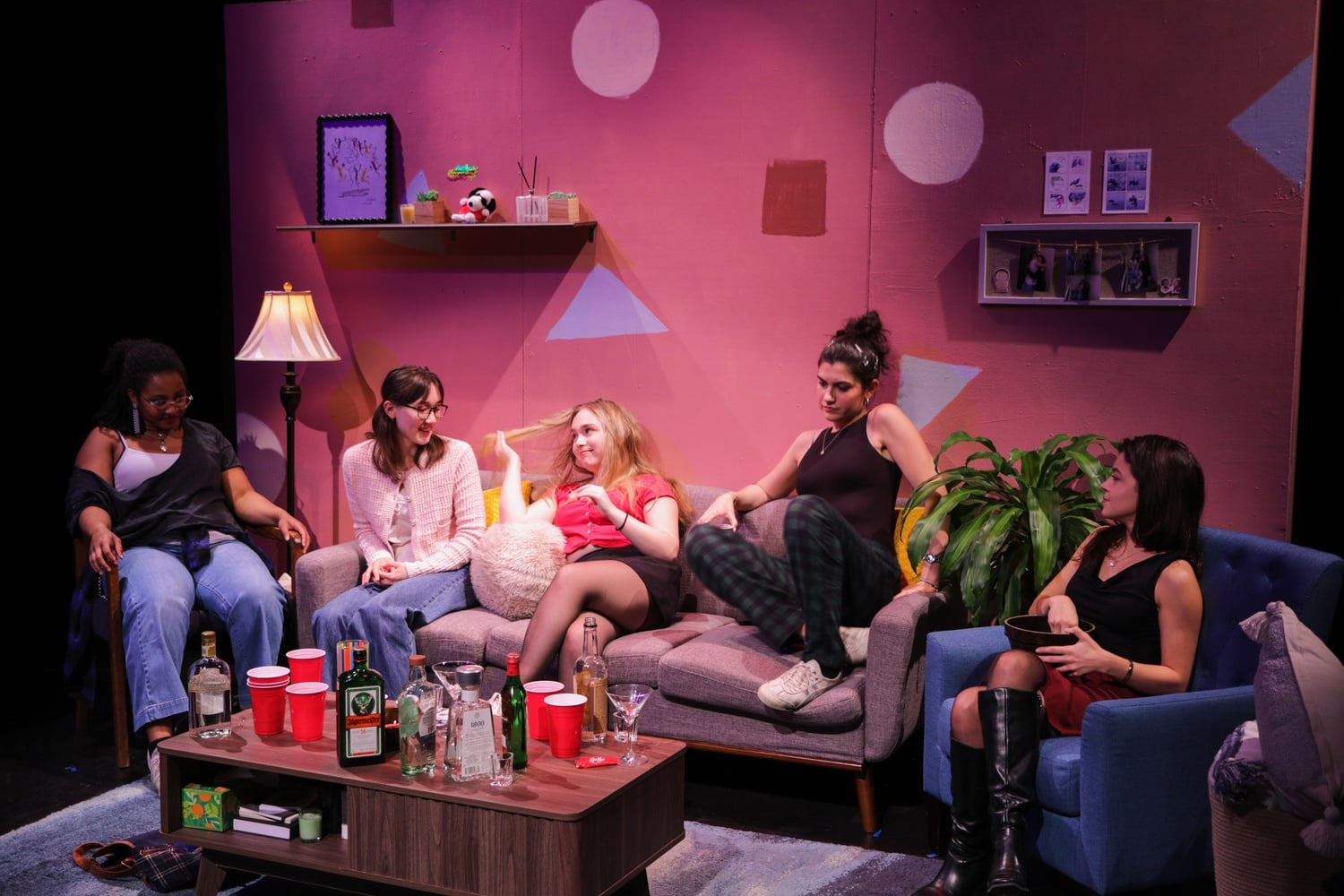
The wide range of personalities represented by the four girls was quickly apparent, with aid from the incredible costume design by Sarah E. Yee ’29: Rachel (Andreea Haidau ’27), the fiercely passionate and ultra-controlling virtuoso in a biz-caz top and skirt; Lexi (Gemma I. Dean ’27), the simultaneously laidback and intense pot stirrer in pajama pants and decked-out silver jewelry; Cam (Tahraji N.L. Milsap ’27), the witty yet emotionally vulnerable underdog in an edgy off-the-shoulder top; and Piper (Daphne Y. Gilman ’30), the compassionate, thoughtful mom of the friend group in a cutesy pink cardigan.
The set design by Shirley Xiong ’27 was also superb. The main performance space was a cozy and realistic depiction of a college dorm, including a cheap-looking couch covered in throw pillows and knickknacks scattered across the shelves. The attention to detail — like a Polaroid wall and theater posters, with help from the intimate nature of the black box — invited the audience to step into the characters’ world. Though moving outward from the center, the set became progressively more abstract. On both sides of the performance space, stools and lamps were hung from the ceiling, foreshadowing the psychological unraveling that was to take place.
Shek demonstrated fine directorial direction through her utilization of the black box concept: As the audience was filing in, Rachel and Lexi were getting ready for the party as characters, placing pillows and putting out Solo cups, while also getting ready for the play as actors. This direction highlighted the meta element of the play: actors are playing actors. Does being an actor inherently define your character outside the theater? When does the stage stop and real life begin? The moment one entered the theater, Shek’s directions immediately asked the audience to delve into these questions.
Haidau gave Rachel a perfect ominous intensity. She artfully walked the line of depicting Rachel’s effort to portray herself as a role model to Hailey, while accidentally revealing her underlying envy through the stiffness of her words and facial expressions.
Strong joint acting moments included Haidau and Dean’s characters’ shared judgy looks throughout the play: this non-verbal acting was noticeable but not overplayed. Both actors’ eyebrow games were particularly on point.
Gilman, in her portrayal of Piper, added a remarkable complexity to a character who could have easily been one-dimensional. Through various comments made throughout the play, Piper reveals she has a very religious upbringing but began to question her faith when she came to college. Her character’s duality was best portrayed in a scene where she debates whether to hang out with a guy friend: Gilman beautifully conveyed her character’s mixture of nervous reticence and innate eagerness.
While Veltry seemed nervous during the first half, it only minimally detracted from her otherwise impressive performance, as her performance was compatible with the feelings of her character. As the play progressed, she became evidently more comfortable, and Hailey’s drunken adlibs added a nice levity to the more tense scenes during the latter half.
Though Milsap was also often successful as the play’s comic relief, she was at her best when acting alongside Gilman. In a vulnerable scene where both characters were opening up about their struggles in the theater department and college generally, the earnestness each of them conveyed when listening to the other’s story allowed the audience to appreciate the depth of each character’s emotional experience.
Toward the end of the play, as tensions escalated and came to a climax, Haidau and Dean took charge of the stage. Rachel’s slow loss of control over herself was brilliantly acted out, and Dean effectively embodied the audience’s shock at this transformation in her role as Lexi.
Shek’s adaptation of the play spotlighted one central theme: Everyone is a freshman at the end of the day. Even those who appear to have everything under control — or are, in fact, in control — can be a complete catastrophe internally. In some ways, this message is at once comforting and disheartening.
“macbitches” asks an important question: Should we try our hardest to avoid the chaos of life, or are we better off embracing it? Whatever the answer, amidst tumultuous friendships and cast list drama, one rule holds true: Keep the scissors at bay.
“macbitches” ran at the Loeb Drama Center from Oct. 8 to Oct. 11.
Want to keep up with breaking news? Subscribe to our email newsletter
Have a tip for The Crimson? Share it confidentially