Former Council of Economic Advisers Chair Questions Nature of Affordability Crisis in HKS Lecture
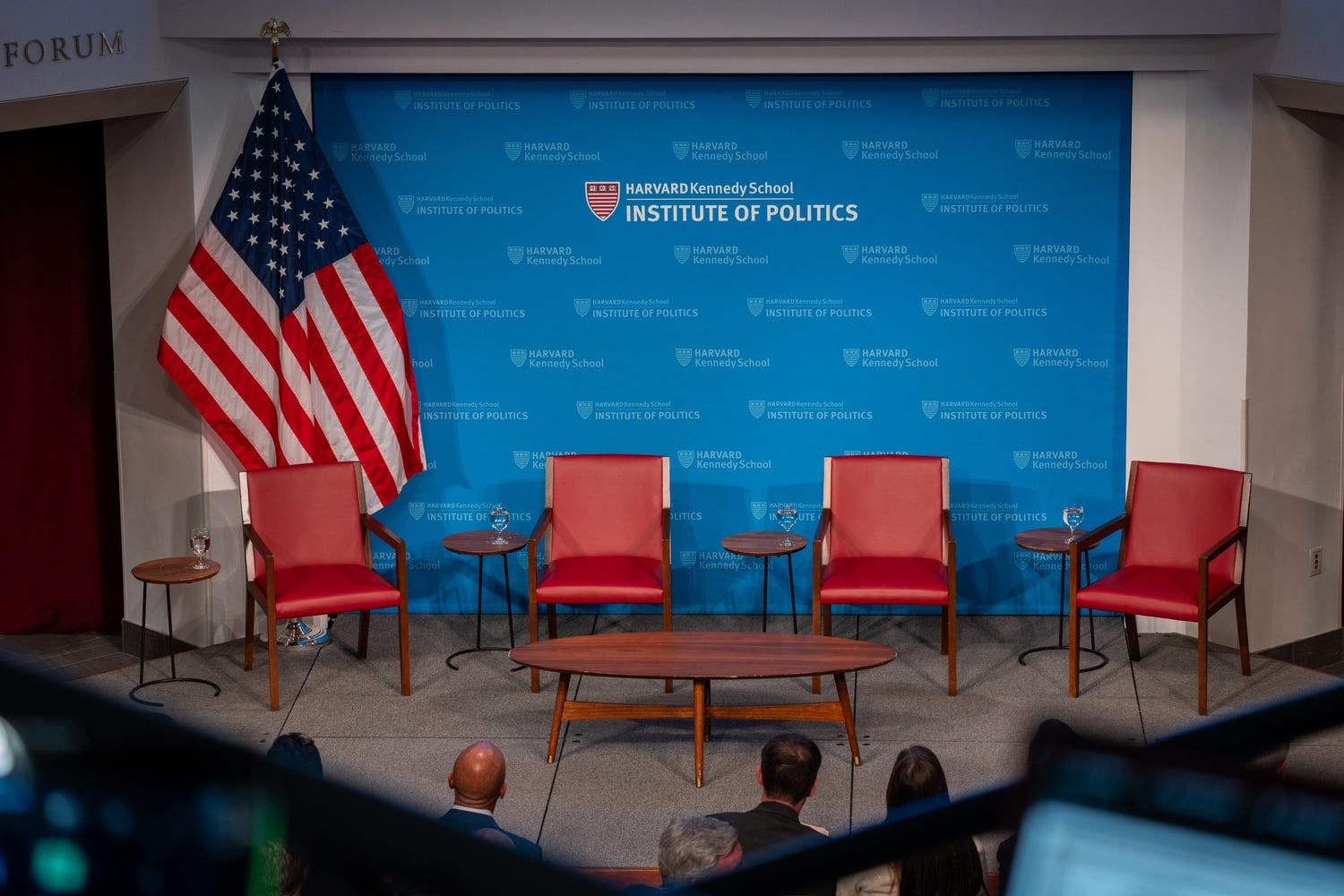
Brookings Institution president Cecilia E. Rouse ’86 questioned whether descriptions of a widespread affordability crisis align with economic data during a Thursday lecture at the Institute of Politics.
Rouse argued that evidence of a widespread affordability crisis was less apparent in measures of working hours, medical care use, educational attainment, and rising debt. But she said affordability concerns had “many dimensions,” pointing to declining homeownership and savings as clearer signs of financial strain.
“We can’t actually address this affordability crisis unless we understand, actually, what it is,” Rouse said during a subsequent question and answer session. “If you don’t properly diagnose the problem, you actually can’t address it, and I’m not so sure we’ve got it right.”
Citing an increase in the share of adults ages 18 to 34 living at home, Rouse suggested that “housing stress” was driving changes in behavior in response to rising prices.
She said Americans were saving “less than you would expect” given economic uncertainty, suggesting that they may be drawing on personal savings to cover current expenses.
“Our whole economy is not working that well for working people,” Rouse said.
A Princeton University economist studying education, Rouse served as the dean of the Princeton School of Public and International Affairs for nine years before chairing the Council of Economic Advisers from 2021 to 2023. She then became president of the Brookings Institute.
Get The Crimson in your inbox.
The Stone Lecture series, hosted by the IOP at the Harvard Kennedy School, brings together scholars of economic inequality to discuss trends of rising wealth concentration. Several prominent economists — including Thomas Piketty, Lina Khan, and Daron Acemoglu — have delivered the lecture in previous years.
Following Rouse’s presentation, Nobel laureate and Harvard professor Claudia D. Goldin moderated a question-and-answer session with attendees. Asked about artificial intelligence’s impact on the job market, Rouse said its immediate impacts remained uncertain. She added that critical thinking and judgement would remain valuable as the technology advances.
“The thing you need to learn is how to think, to develop a judgment,” Rouse said. “I would encourage you to use AI strategically and judiciously, and not use it to cut corners, because then you will not be as valuable to the people who are trying to hire you.”
Rouse said AI may also be contributing to perceptions of economic uncertainty, citing the potential for workforce automation and a “capital intensive” economy that could deepen inequality by concentrating gains among a handful of investors.
Though uncertain whether AI would displace existing jobs, she cautioned that the technology could have broader consequences beyond employment.
“Even if it does have some of the more benign impacts on actual employment, I think there’s going to be other impacts on other aspects of our society,” Rouse said.
Want to keep up with breaking news? Subscribe to our email newsletter
Have a tip for The Crimson? Share it confidentially