Harvard Administrators Press Faculty to Report Striking TFs As Few Self-Report
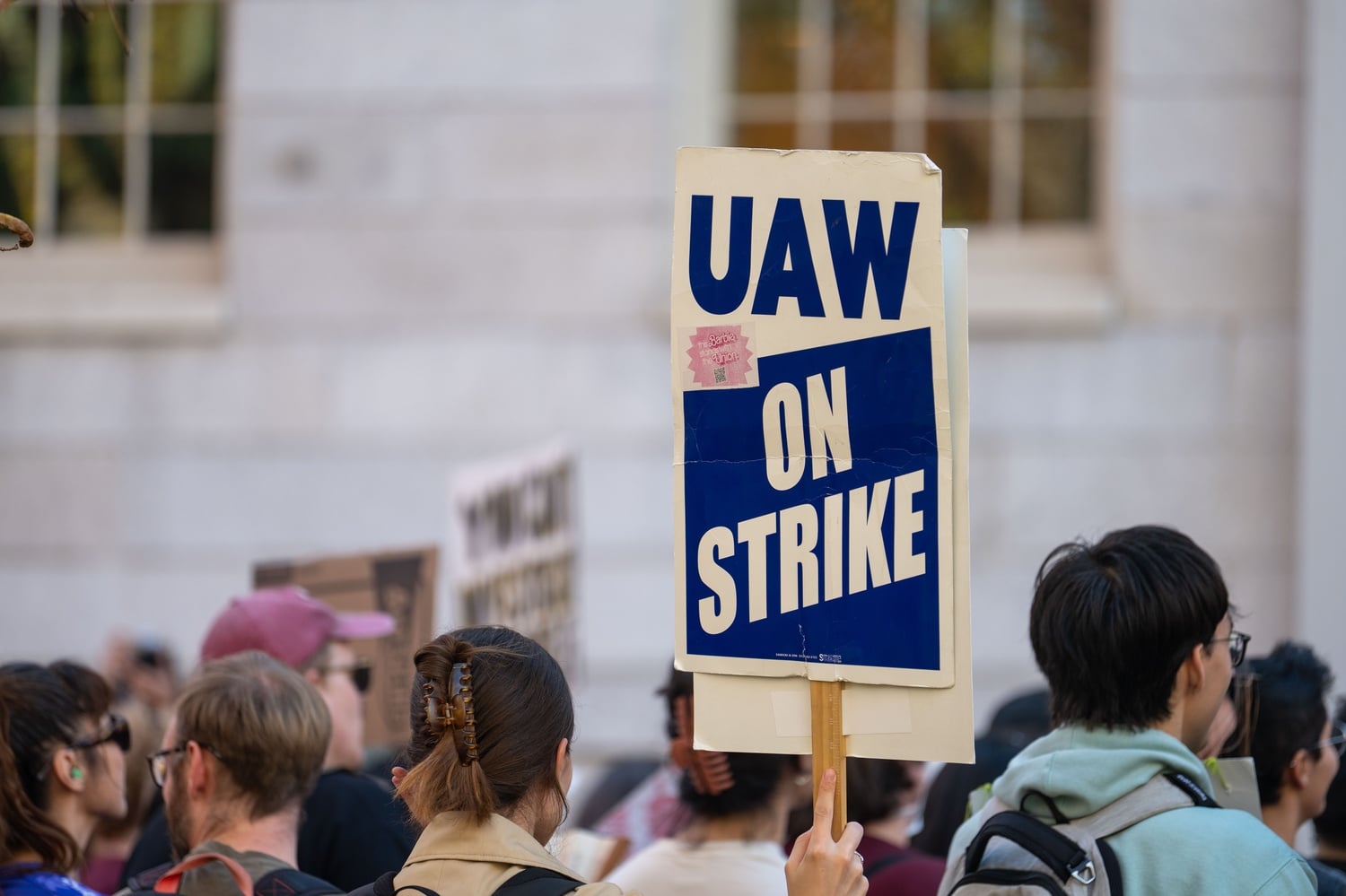
Weeks after graduate students walked off the job, Harvard administrators are still struggling to deduct pay from striking workers — hampered by the graduate union’s repeated assertions that strikers do not need to report time not worked.
Harvard has asked salaried workers to use PeopleSoft, an online platform, to record time not worked so administrators can deduct pay. Dean of Undergraduate Education Amanda Claybaugh told directors and assistant directors of undergraduate studies on Friday that 80 teaching fellows had reported as striking, according to an attendee and two people familiar with the meeting — roughly two percent of the 4,000 workers represented by the union.
Union members can collect up to $550 a week from the union’s strike fund if they face pay deductions. But if only 80 have self-reported, many more strikers could still be drawing pay from Harvard.
The union has argued that Harvard will use lists of strikers to discipline workers and that requirements to self-report are unlawful because they are imposed “unilaterally and coercively,” Harvard Graduate Students Union-United Auto Workers President Denish K. Jaswal wrote in a statement.
But in a Monday email to DUSes, Claybaugh wrote that “the expectation that workers can strike and still be paid is patently unreasonable,” noting that workers in Harvard’s non-tenure-track faculty union had been self-reporting during their concurrent strike — which ended Tuesday — and that both dining workers and clerical workers usually did so.
She did not directly reference a dearth of self-reporting in the email, but gave faculty a strict mandate to report striking workers.
“Instructors are required to report striking TFs,” she wrote. “The university needs to know who is striking so that people are not paid for work they are not performing.”
Graduate students have been striking since Oct. 27, after negotiations stalled over key demands the union touted during earlier contract campaigns — higher wages, third-party arbitration for discrimination and harassment cases, and an agency shop.
Their interactions with the University have become increasingly fraught in recent weeks. Harvard has accused striking workers of violating university policies during demonstrations multiple times, and a Nov. 5 bargaining session ended abruptly after comments from a UAW representative prompted a University representative to leave the room.
The disputes over pay have also intensified, though non-reporting first emerged as an issue during HGSU-UAW’s 40-day strike this spring.
Get The Crimson in your inbox.
The union wrote in a strike guide for workers that Harvard was largely unable to identify strikers or deduct pay this spring, with the exception of fewer than 20 workers who were in the press or whose supervisors reported them for striking.
In an April message to student workers, administrators wrote that strikers were not entitled to regular pay while on strike and that the University had “obligations to accurately report effort and labor, including obligations related to federal funding.”
They added that workers would need to report “Time at Own Expense” on PeopleSoft for days they did not perform work because they were striking.
The union alleged in a Nov. 11 email to faculty that Harvard disciplined student workers whom faculty members reported as striking during this spring’s walkout.
But Paul R. Curran, managing director of Harvard’s Office of Labor and Employee Relations, contested that account in a Nov. 14 message to HGSU-UAW leaders.
“You are simply incorrect in suggesting the University has used lists of students to discipline student workers for participating in a strike,” he wrote.
“Only student workers who had been compensated for work they didn’t do and then refused directives to correct their time records had been disciplined,” he added.
Claybaugh referenced another spring incident at the Friday meeting and a similar Nov. 12 meeting with DUSes and ADUSes. Some workers had been disciplined not for striking but for locking the doors to the bathrooms in 124 Mt. Auburn St. — the building where contract negotiations take place, she said, according to an attendee at the Friday meeting and a person familiar with the Nov. 12 meeting.
In response to a request for comment, Claybaugh said she had wanted her discussion with DUSes and ADUSes to remain within the room.
“The DUS meetings were confidential conversations with colleagues,” she wrote in a statement. “I am disappointed that some of those colleagues chose to go to the Crimson.”
Claybaugh’s comments came amid increasing pressure from faculty to address a work stoppage that — alongside a non-tenure-track faculty strike — had brought some classes to a standstill.
At the Friday meeting with DUSes, Claybaugh said parents had been reaching out concerned that classes were being cancelled, according to an attendee.
In the Monday email to DUSes, Claybaugh made her expectations explicit: Course heads needed to ensure classes continued, and the University would pay for someone to take over instruction if necessary.
Claybaugh floated using non-striking TFs and TAs as replacements. She added that rules had been “temporarily relaxed” to allow students on dissertation completion fellowships to fill in.
She suggested that if instructors were concerned about strike disruptions or did not want to cross picket lines, they could hold class over Zoom or off campus.
“Under no circumstances should course heads be cancelling lectures,” she wrote in the email.
Claybaugh added that she had heard some undergraduates had been told by TFs not to share that their TFs were striking. The undergraduates were reluctant to attend extra office hours out of fear that attending would out their striking TFs, she wrote.
“I am very troubled by these reports; our undergraduates should never be dissuaded from seeking out instruction. If this is happening in your department, please let me know. I’ll try to help you find a solution,” she wrote.
At the Nov. 12 DUS meeting, Claybaugh also fielded questions from faculty curious about the overall impact of the strike and potential data collection on class disruptions. She said a survey could potentially be sent out, according to a person familiar with the meeting.
At the Friday meeting, she briefly voiced concern that data might end up in the news, according to an attendee.
But administrators have already begun to request information. Molecular and Cellular Biology professor Sam Kunes wrote in a Tuesday email to affiliates that the Division of Science was gathering information on the strike’s impact on fall courses. He urged faculty to address a series of questions on how their classes had been disrupted “as soon as possible.”
FAS spokesperson James M. Chisholm wrote in a statement that “asking faculty to share the impact of the strike on advising, teaching, and classroom learning is a normal and responsible step in supporting our undergraduate students.”
“We need that information to maintain academic continuity and identify where support and resources might be needed,” he added.
—Staff writer Abigail S. Gerstein can be reached at [email protected] and on Signal at abbysg.97. Follow her on X @abbysgerstein.
—Staff writer Amann S. Mahajan can be reached at [email protected] and on Signal at amannsm.38. Follow her on X @amannmahajan.
Want to keep up with breaking news? Subscribe to our email newsletter
Have a tip for The Crimson? Share it confidentially