Harvard Law Graduates Land Clerkships Across Federal Judiciary, Fueled by Alumni Ties
Harvard Law graduates have secured clerkships with nearly nine in ten federal appeals court judges appointed since 2004, but a Crimson analysis of more than 5,000 reported acceptances reveals stark disparities in hiring patterns, with alumni connections, political affiliation, and geography playing significant roles.

Harvard Law School graduates have secured clerkships with nearly nine in ten federal appeals court judges appointed since 2004, according to a Crimson analysis of more than 5,000 reported clerkship acceptances.
But the Law School’s reach across the federal judiciary is far from uniform. Judges who graduated from HLS take on its alumni at disproportionately high rates, while Democratic-appointed district judges have accepted significantly more Harvard Law clerks than their Republican-appointed counterparts.
The Crimson obtained and analyzed an internal HLS Office of Career Services report, which records at least one clerkship acceptance for 174 of 196 appeals court judges and 359 of 801 district court judges since 2004. The data includes future placements and acceptances reported to HLS, not necessarily a complete tally. Because reporting was inconsistent before 2009, most year-by-year comparisons included in the analysis begin that year.
Clerkships, typically one or two-year positions in which recent law school graduates conduct legal research and help judges draft opinions, are among the legal profession’s most coveted early-career credentials. Their prestige can open doors at law firms, in government, and in academia.
Harvard Kennedy School professor Maya Sen ’00, who studies federal courts, said clerkships are “really valuable” as both a professional experience and a powerful credential.
“They’re an important prestige marker in terms of distinguishing yourself from other young lawyers. They’re also particularly valuable for certain kinds of legal careers, and they’re especially valuable for financial reasons,” Sen said. “They can be really generously compensated by private law firms.”
Tracy E. George, a Vanderbilt Law School professor who researches judicial hiring, said clerks also benefit from the connections they build with judges.
“Any judicial clerkship provides returns on investment in the form of the network that you establish, judges, federal judges in particular, but certain state judges and state high court judges don’t get their jobs by accident,” George said. “They get their jobs because they’re incredibly well connected professionally.”
“We found that judges view their clerks like family, and that they feel invested in their post clerkship success,” she added.
The number of reported clerkships beginning each year rose from 229 in 2010 rising to 300 in 2024 and 2025, according to the database. The increase came largely from federal appeals and district court clerkships, which rose from 83 and 88, respectively, in 2010 to annual averages of 116 and 27 from 2023 through 2025.
Get The Crimson in your inbox.
In recent years, federal courts of all types have accounted for roughly nine in ten acceptances, with Supreme Court, state court, and other positions making up a smaller share.
HLS spokesperson Lacey J. Rose wrote that clerkships are an “extraordinary opportunity” for HLS graduates, pointing to its alumni’s “exceptional record of success” in obtaining the positions across ideological lines from federal, state, and international courts.
“Harvard Law School provides extensive resources and individualized advising to help students and alumni from all backgrounds and perspectives explore clerkship opportunities and pursue positions that align with their interests and professional goals,” she wrote.
After The Crimson requested comment on its findings, HLS removed the names of former clerks from the internal clerkship listing and cited privacy concerns on the page. Rose did not respond to a separate request for comment on the change.
Alumni Connections
Judges who graduated from HLS were disproportionately represented among the judges taking on its graduates. Although HLS alumni made up just 14 percent of appeals court judges and 8 percent of district judges, they accounted for 27 percent and 25 percent of reported HLS clerkships at those courts, respectively.
On a per-judge basis, HLS alumni received more than twice as many reported HLS clerkship acceptances annually as other appeals court judges and roughly four times as many as other district court judges. HLS graduates on appeals courts averaged about 0.9 acceptances per year, compared with about 0.4 for other judges. The comparable figures for district courts were 0.4 and 0.1.
The disparity expanded to the Supreme Court, where nearly 60 percent of reported HLS Supreme Court clerkships were with justices who themselves graduated from the Law School.
“The public narrative right now is Harvard is a kind of public enemy number one, and Harvard students might be disadvantaged by this administration,” Sen said. “But it sounds like maybe the bigger story is not that they’re favored by one party and disfavored by another, but that they’re really able to seriously leverage alumni connections in a very effective way.”
“They hire their own at much higher rates,” she added.
First Circuit Judge Sandra L. Lynch, appointed by President Bill Clinton, has taken on the most HLS graduates as clerks, with 45 reported acceptances in the database. Northern District of New York Judge Lawrence E. Kahn has hired the most among judges who graduated from HLS, with 31.
Two Supreme Court justices are among the 15 judges with the most reported HLS clerkships — Chief Justice John Roberts ’76 with 28 and Justice Elena Kagan, a former HLS dean, with 27.
Twelve of the top 17 judges were HLS graduates. Three also serve as HLS lecturers — Patti B. Saris ’73, Jeffrey S. Sutton, and David J. Barron ’89 with 29, 22, and 21 reported clerkships, respectively.
HLS professor Noah R. Feldman ’92 said professional relationships between academics and judges can help judges assess hundreds of clerkship applications.
“There are a lot of law professors out there, and a lot of judges, and as in any application process in any sphere, some point of recognition or commonality can absolutely be helpful to the judge in making a decision,” Feldman said.
The data also revealed differences in clerkship acceptances based on the political affiliation of the president who appointed each judge, particularly at the district court level.
On appeals courts, Democratic-appointed judges averaged 4.7 reported HLS clerkship acceptances each over the period analyzed, compared with 4.4 among Republican appointees. The gap was wider on district courts, where Democratic appointees averaged 1.4 acceptances per judge, compared with 0.8 for Republican appointees.
Democratic appointees made up about 53 percent of active district judges during the period analyzed but accounted for roughly 66 percent of reported HLS district court clerkships. On appeals courts, the two parties’ appointees attracted roughly proportional shares.
Daniel R. Nivens, president of the HLS Federalist Society, pointed to strong demand for conservative Harvard Law clerks among Republican-appointed judges.
“It would make sense that you would see more circuit court clerkships in general, particularly going to more recently Republican appointed judges, because, there’s, as I mentioned earlier, pretty high demand for Harvard Law students in clerkships, and there are fewer conservative Harvard Law students and a lot of Republican appointed judges,” Nivens said.
The differences were smaller when the analysis accounted for judges’ time on the federal bench. Judges appointed by Presidents Barack Obama, Joe Biden, and Donald Trump during his first term each averaged about 0.2 reported HLS clerkships acceptances per year. Bill Clinton and George W. Bush appointees averaged 0.17 and 0.15, respectively, while appointees of Jimmy Carter, Ronald Reagan and George H.W. Bush averaged about 0.1.
The pattern of HLS graduates hiring fellow alumni held across party lines. Among judges who graduated from HLS, George W. Bush and Obama appointees each received roughly eight reported HLS clerkships acceptances on average over their time on the bench, compared with 7.4 for Clinton appointees.
Eighteen of Biden’s 21 HLS appointees have had a reported HLS clerkship acceptance, as have 18 of 20 for Trump appointees from his first term, 33 of 37 Obama appointees, and 17 of 19 George W. Bush appointees.
Some judges have historically hired “counter-clerks,” or clerks with different political ideologies, to bring diverse perspectives to their chambers. But researchers say the clerkship process has become more ideological over time, with the judge a graduate clerks for potentially signaling their political views.
“One judge mentioned to us that there’s this concern among clerks that if they work for a conservative feeder judge, it might hurt their chances with a liberal justice, and vice versa,” said University of Toronto law professor Albert Yoon, who has researched clerkships. “It means that there’s more sort of kind of ideological consistency maybe in the clerkship process than there might have been a generation ago.”
Geographic Disparities
Harvard Law’s clerkship pipeline is concentrated geographically, too, with courts in New York, Massachusetts, and Washington, D.C., accounting for a disproportionate share of reported placements.
Students may consider several factors when deciding whether to clerk for a particular judge, including ideological alignment and geographic region, particularly if they hope to practice law in the same area.
On appeals courts, the 9th Circuit accounted for about 15 percent of reported HLS clerkships, followed by 13 percent in the 2nd Circuit and 10 percent in the D.C. circuit. Together, the three circuits account for roughly 40 percent of clerkships in a typical year.
The 9th Circuit covers much of the western United States, including California, Idaho, Montana, Nevada, Alaska, and Hawaii. The 2nd Circuit covers New York, Connecticut, and Vermont.
But the largest circuits did not necessarily receive the most HLS clerks relative to their size.
Adjusted for the number of appellate judges, the 1st Circuit received the most HLS clerks, about 1.04 per judge per year — more than twice the circuit average of 0.47 — followed by the D.C. Circuit at 0.82. The 7th, 8th and Federal Circuits drew the fewest per judge, with 0.33, 0.39 and 0.20, respectively.
At the district court level, the 2nd Circuit region accounted for about 27 percent of HLS clerkships, followed by the 9th Circuit at 15 percent and the 1st Circuit region — which includes Massachusetts — at 10 percent. Together, the three regions accounted for more than half of reported district court clerkships. The 2nd Circuit region led in 16 of 18 years.
That concentration was especially pronounced when compared with the number of judges in each region. The 2nd Circuit region accounted for just 9 percent of active district judges, while the 1st Circuit region accounted for 4 percent.
Adjusted for the number of active district judges, D.C. received about 0.4 HLS clerks per judge per year — or more than three times the district average of 0.12 — followed by the 2nd Circuit region at 0.30 and the 1st Circuit region at 0.29.
The Southern District of New York led with 315 reported clerkships since 2009, accounting for about 17 percent of HLS district court clerkships. Other major destinations included the District of Massachusetts with 153, the District of Columbia with 146, the Eastern District of New York with 121, and the Central District of California with 103.
But Harvard’s reach remained limited in some parts of the country.
Some districts have large numbers of active judges with no reported HLS clerkships, even among those who have served at least three years. All seven judges in the District of South Carolina and eight of 10 in the District Court of Arizona have had no HLS clerkship acceptances on record, followed by seven of 11 in the Eastern District of Michigan and seven of 10 in the Northern District of Ohio and Western District of Pennsylvania.
Hiring Pipelines
The timing of Harvard Law clerkships has also shifted, with a growing share of graduates beginning their placements at least a year after graduation.
The share of reported clerkships beginning immediately after graduation fell from 62 percent in 2009 to about 39 percent in 2026. Over the same period, the share beginning at least one year after graduation rose 38 percent to 61 percent, while those beginning exactly two years after graduation rose from 8 percent to 24 percent.
Former federal judge Jeremy Fogel, now at the University of California, Berkeley, said work experience gave him another way to evaluate applicants beyond law school grades, recommendations and class rank.
“After I’d been on the bench a couple years, I stopped hiring straight throughs,” Fogel said. “How did they do out in the world? How do they do with the people they worked with out in the world? What did they learn from that?”
“It also really helped with my nontraditional candidates that if they say had not gone to an elite school or if they had but they hadn’t been like in the top of their class,” he added.
While some graduates spend time working before beginning clerkships, other face delays because judges have already filled their openings years in advance.
“It’s just an artifact of the hiring where you know even if a judge wants to hire you, they may have hired for the next year or the year end,” Yoon said. “The next opening is somewhere kind of again into the future, which could be a couple years away.”
Students also navigate different hiring timelines, with some applying through a formal process and others securing clerkships through informal networks much earlier in law school.
Typically, students would apply for “on-plan,” through a formal application process coordinated on a standardized timeline during their second year of law school, often submitting dozens of applications across the country.
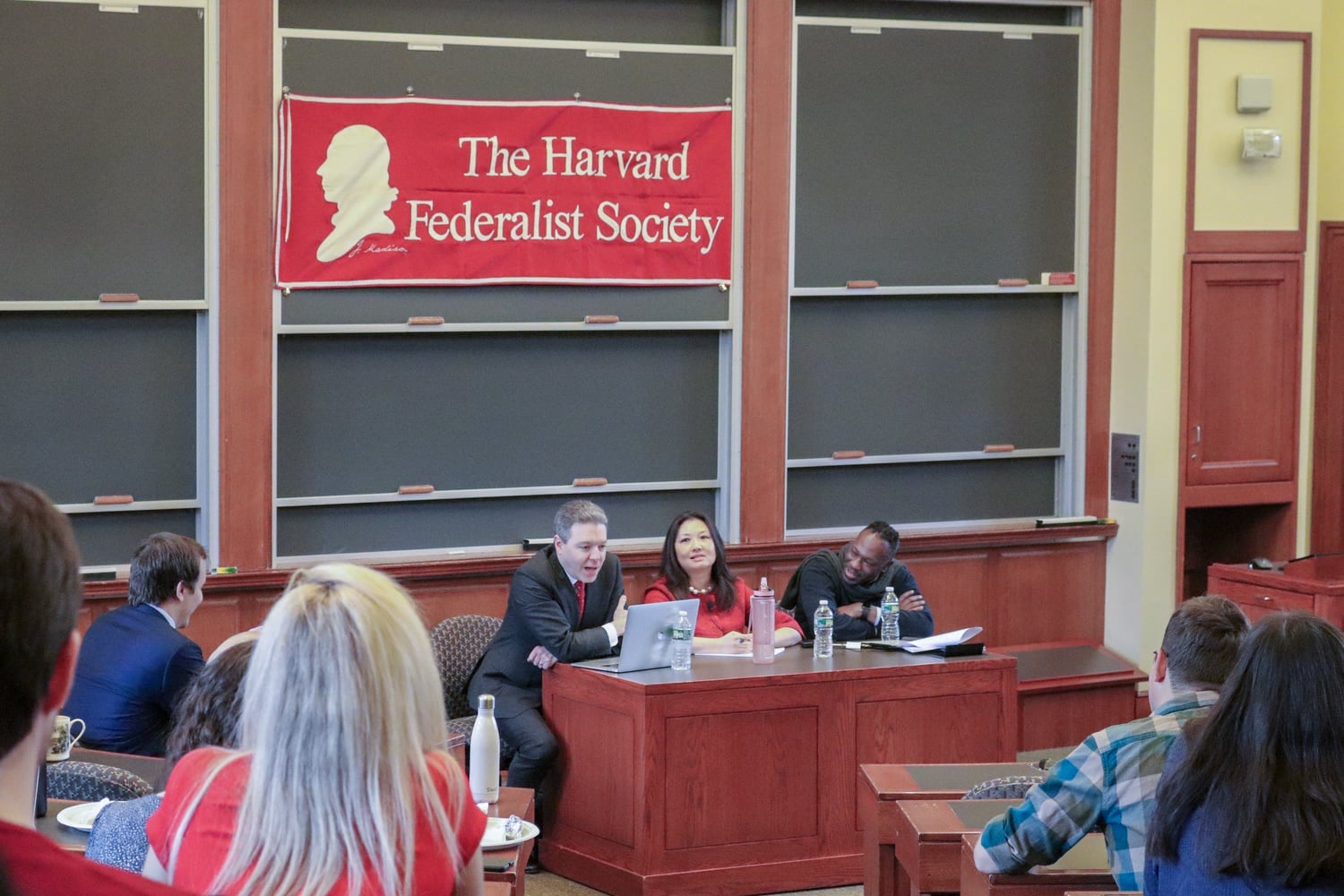
But some conservative students — often affiliated with the Federalist Society for Law and Public Policy Studies — are being recruited earlier, during their first year. Members of the HLS Federalist Society said informal networks connect students with professors, judges, and current clerks who can evaluate potential applicants before the formal application process opens.
The chapter hosts informational sessions about the off-plan hiring process, brings federal judges to campus for speaker events, and connects students with judges through coffee chats and small group-dinners organized through a lottery system, according to Nivens.
The data appears to reflect the trend. Seven second-year law students in the Class of 2028 have already reported clerkship acceptances, all with Trump-appointed judges. All seven clerkships are scheduled to bring in 2028, the students’ graduation year. Five are in the 6th Circuit region.
“Just in general, there are very few judges that our members are interested in clerking for who hire on plan, but there’s definitely been cases of people still doing mock interviews and things like that as they’re applying later on,” Nivens said. “The additional thing is Harvard’s resources kick in at the time that you’re getting to applying for on-plan judges, so it’s just slightly less relevant what we’re doing.”
“I would imagine there are probably more, and there’s just going to be a lower rate of self-reporting,” he added.
HLS Democrats has expanded its offerings to include academic and career advising, in part to provide support similar to that offered by the Federalist Society, according to HLS Dems co-president and second-year law student Aastha Sinha.
Most members of the HLS chapter of the American Constitution Society typically pursue clerkships with judges who hire on-plan. The chapter pairs students with third-year law students who have secured clerkships and connects them with its alumni network of clerks via panels and other events.
Beyond those initial hiring networks, a smaller group of federal judges serves as a particularly important pathway to the Supreme Court.
A separate HLS webpage lists 192 HLS graduates who secured Supreme Court clerkships between 1991 to 2028, many of whom previously worked for “feeder judges,” jurists whose clerks frequently go on to clerk at the Supreme Court.
Four judges — Sutton, former Judge Merrick B. Garland ’74, then-Circuit Court Judge Brett M. Kavanaugh, and Judge Laurence H. Silberman — each had 11 HLS clerks go on to the Supreme Court. Former Judge Michael Boudin ’61 followed with 10, while then-Circuit Judge Neil M. Gorsuch and Judges Gregory G. Katsas, J. Harvie Wilkinson III, and J. Michael Luttig each had nine.
The leading feeder judges have shifted over time. Since 2016, Katsas has sent nine HLS clerks to the Supreme Court, followed by Sutton with eight. Five of Katsas’s six HLS clerks listed in separate annual records covering 2021 through 2028 also secured Supreme Court clerkships.
About 40 percent of HLS Supreme Court clerks in the separate list previously clerked on the D.C. Circuit first, while 6th Circuit judges accounted for about 16 percent of more recent placements.
Each justice also draws from a particular set of judges. Six of Chief Justice Roberts’s 32 recent HLS clerks previously clerked for Sutton, while four clerked for Kavanaugh, a former HLS lecturer. Of Kagan’s 28 HLS clerks, four each previously clerked for Sri Srinivasan and Garland followed by three each for James E. Boasberg, Thomas B. Griffith, and Stephen R. Reinhardt.
Eight of Justice Sonia Sotomayor’s 17 HLS clerks previously clerked in the 2nd Circuit region, including four of the six listed since 2021.
Two of the reported Class of 2028 clerkships are possible feeder judges: Circuit Judges Andrew S. Oldham and newly confirmed Whitney D. Hermandorfer, who previously clerked for Kavanaugh and Justices Samuel Alito and Amy Coney Barrett.
Massachusetts Appeals Court Justice Peter J. Rubin, who also teaches at HLS, said hiring Harvard Law graduates reflects the school’s reputation, though he emphasized that strong clerks also come from other institutions.
“I love to have law clerks from Harvard, and I’ve had several. I’ve just hired one for next year. It’s not that it’s my alma mater, really,” Rubin said. “It’s such an excellent law school, so I love having clerks from Harvard. I’ve had great clerks from Yale, Michigan, but I’ve had great clerks from other schools as well.”
Yoon says the importance judges place on applicants’ education backgrounds is unsurprising.
“It’s human nature to attach some weight to things that you know that sends strong signals,” Yoon said.
—Staff writer Uy B. Pham can be reached at [email protected] or on Signal at ubp.88. Follow him on X @uybpham.
Want to keep up with breaking news? Subscribe to our email newsletter
Have a tip for The Crimson? Share it confidentially