Physics Faculty Lose Bid to Preserve Grant Administrator’s Role Under FAS Restructuring
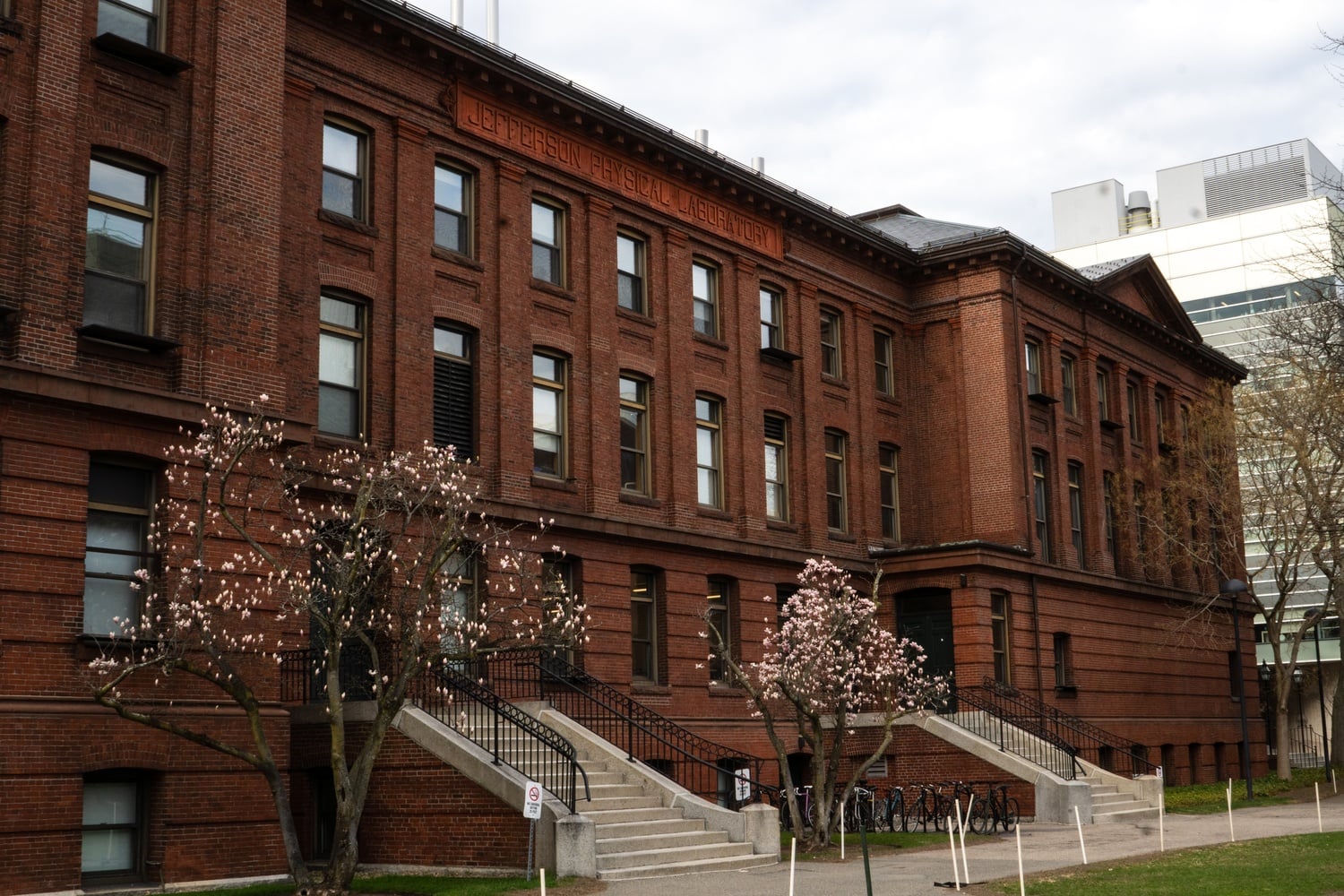
Physics faculty waged an unsuccessful campaign last month to preserve the job functions of the administrator overseeing the department’s roughly $150 million research portfolio, and are now racing to get grants in order before a Faculty of Arts and Sciences restructuring splits pre- and post-award management in October.
Adam A. Ackerman, the department’s associate director of sponsored research, will leave Harvard in October after more than 20 years at the University, ending a dispute between Physics faculty and FAS administrators over how the restructuring would reshape grant management in one of the school’s heavily funded departments.
Under the new model, grant work historically handled by a single department staffer across an award’s full life cycle will be divided between two teams, reporting to the Office for Sponsored Programs and the FAS Office of Research Administration rather than to department leadership. The change is part of a restructuring that eliminated 165 staff positions and moved other employees into new or changed roles as the FAS works to close a $365 million structural deficit.
FAS spokesperson James M. Chisholm confirmed the split in a statement, writing that administrators “recognize that there are tradeoffs in shifting to a new organizational model, and the OSP and FORA are closely coordinating on the transition.”
The split poses a sharper challenge for Physics than for most FAS departments. Physics has roughly $150 million total in awards in its portfolio, according to Ackerman. It spent upwards of $30 million on sponsored expenses in fiscal year 2026, financial documents obtained by The Crimson show.
With the help of grant managers, principal investigators must track spending down to the dollar, file regular reports, and clear compliance audits, a workload that faculty said has grown heavier as awards have gotten more complicated.
Ackerman has run that operation, helping faculty shape proposals and overseeing other grant managers. During the restructuring, he was offered a new position at a lower salary grade consisting largely of post-award duties and reporting to FORA. Colleagues handling pre-award work would report to OSP instead.
Faced with the changes to his job, Ackerman began weighing an exit.
“You’re just reconciling things essentially on the back end, so you’re not really involved with the PI, getting the strategy set up and helping them connect an award from that beginning, right?” he said. “So for me, that just didn’t work.”
On Aug. 17, Physics chair Aravinthan D. T. Samuel sent a letter signed by 26 other faculty to FAS Dean Hopi E. Hoekstra, FAS Dean of Administration and Finance Warren Petrofsky, Chief FAS Research Administration Officer Kris Monahan, and Senior Vice Provost for Research John H. Shaw. The signatories asked the school to preserve a “continuing managerial voice” for Ackerman over Physics grants and staff, warning that losing him would be a “serious and avoidable blow.”
Get The Crimson in your inbox.
The faculty wrote that they accepted the pre- and post-award split as settled, but feared it would “fragment a team that has worked exceptionally well and damage the connective tissue that allows our complex grants to be managed successfully from start to finish.”
“Awards to Physics have become much more complex in recent years. Pre- and post-award management may be divided formally, but the work cannot be allowed to separate functionally,” they wrote. “Physics needs connective tissue in the new structure: clear mechanisms that keep pre- and post-award staff connected around the same faculty portfolios, with Adam retaining a meaningful role in coordinating that continuity.”
FORA extended a second offer to Ackerman — which would add the word “senior” in front of his title — without changing his salary grade or duties. He turned the role down, and will be leaving Harvard in October.
With the transition weeks away, faculty are trying to clear as much paperwork as they can. Susanne Yelin, a professor of physics in residence, wrote in a statement that she expects “enough chaos in the transition to cost a lot of faculty time at best, and some inadvertent non-compliance at worst.”
“I am seriously afraid (and I have more than 10 grants right now and a lot of people to pay out of them),” she wrote.
Physics professor Subir Sachdev, who said his work is largely theoretical, said he was less worried — but that he is still front-loading his administrative work.
“I just started working on a new grant with one of the people in our office, and she said, ‘Well, let’s try to get this done before mid-October,’” he said.
Elsewhere in the sciences, the alarm is quieter. The Department of Molecular and Cellular Biology once ran on a pre- and post-award split of its own before moving away from it, and MCB professor Florian Engert said the new structure is not ideal but workable.
“It’s probably a good idea to have the same person shepherd you through the application process, and then also manage the money if you get the grant,” Engert said. “But I think if those are two separate people, personally, I don’t think that that’s a catastrophe.”
Still, MCB professor Venkatesh N. Murthy said faculty have yet to hear a persuasive case for the change.
“I think for many of us, it’s opaque. Why an existing well-functioning method across many departments—why that was changed?”
—Staff writer Abigail S. Gerstein can be reached at [email protected] and on Signal at abbysg.97. Follow her on X @abbysgerstein.
—Staff writer Amann S. Mahajan can be reached at [email protected] and on Signal at amannsm.38. Follow her on X @amannmahajan.
Want to keep up with breaking news? Subscribe to our email newsletter
Have a tip for The Crimson? Share it confidentially