City Council Backs Stricter Sewage Overflow Recommendations in Draft Proposal
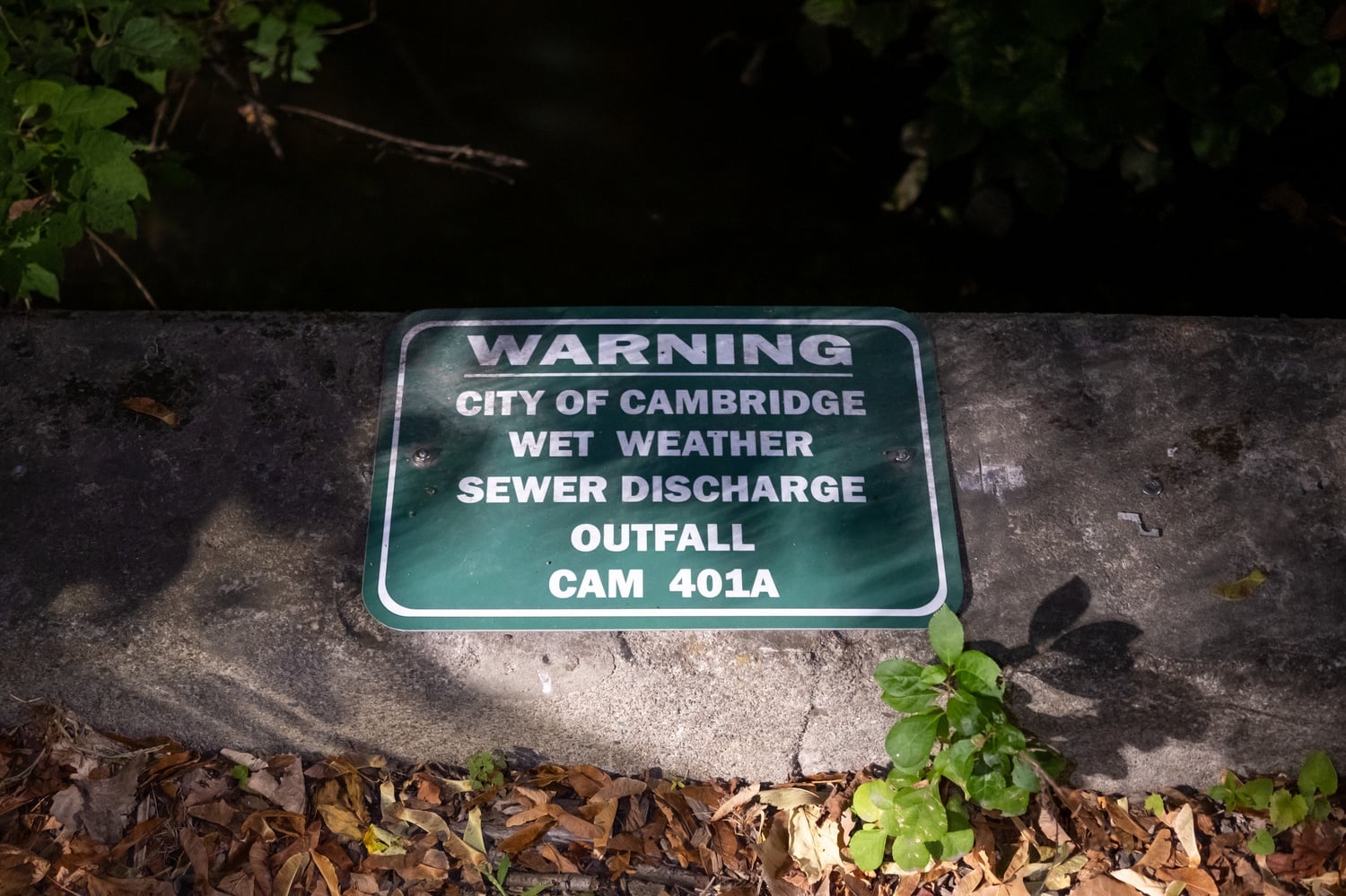
The Cambridge City Council voted unanimously to back a stricter version of a draft plan to limit sewage overflows into the Charles River on Monday.
The move comes as the Massachusetts Water Resources Authority pushes to finalize a long-term control plan for Combined Sewer Overflows under the Clean Water Act. CSOs collect both wastewater and rainwater. During heavy rainfall, the systems become overloaded and release excess into Greater Boston waterways, including the Alewife Brook, and Mystic and Charles Rivers.
The MWRA published a draft plan in April, which would reduce but not fully eliminate CSOs in a typical year. But the plan faced pushback from residents and advocacy groups who argued that continued sewage overflows could pose public health risks.
The policy order — sponsored by Mayor Sumbul Siddiqui, Vice Mayor Burhan Azeem, and Councilors Jivan G. Sobrinho-Wheeler and Patricia M. “Patty” Nolan ’80 — was intended to push the Council to “positively influence the Draft Updated CSO Control Plan and advocate for virtual elimination of Combined Sewer Overflows in the future.”
The April draft plan is in the public review process, which ends on Oct. 30. It lays out four possible options, all modeled after the rainfall expected in a typical year in 2050, accounting for increased rainfall due to climate change. The options range from allowing limited CSOs in a typical year to barring overflows even under the most extreme predicted rainfall — which would require extensive remodeling of the existing sewage infrastructure.
Unlike modern sewer systems, which use separate pipes for stormwater and sewage, older systems in the Boston area carry both through the same network. Normally, the combined flow is sent to treatment facilities. However, in heavy rainfall, water volume exceeds the system’s capacity, triggering wastewater discharge into nearby waterways.
The proposal recommends pushing towards zero CSOs in a typical year, the third strictest of the proposed options. And the cost necessary to do so is estimated at nearly $1.3 billion, which would be split between Cambridge, Somerville, and the MWRA.
Watershed advocacy groups have advocated for a plan that would prevent CSOs almost entirely — only allowing discharges in the heaviest rainfall, expected once every 25 years. But the Council was hesitant to back the strictest regulation because it was estimated to cost roughly $4.74 billion, according to the MWRA’s draft.
However, advocacy groups argue that, for any of the plans, the price tag would be less extreme than it seems. To prevent CSOs in a typical year, Cambridge would be expected to spend roughly $275 million of the total $1.3 billion.
Get The Crimson in your inbox.
“$2 billion sounds like a lot of money, but it’s spread across 2 million people across 30 plus years,” said Emily Norton, the executive director of the Cambridge River Watershed Association. “So it’s actually not that much money in order to get sewage out of our rivers.”
Earlier this year, the Massachusetts State House approved a $30 million allocation to help eliminate CSOs in the Alewife Brook. Somerville will have a city council meeting later this week where they will vote on whether or not to oppose the current drafted CSO long-term control plan.
Watershed groups also contend that none of the control plans proposed so far resolve the underlying issue — a centuries-old water management system. Advocates have pushed for an overhaul of the sewage system, which could separate waste and rainwater collection systems.
“Rather than having a CSO storage tank where there’s going to be sewage stored right next to our houses, we would prefer for it to be a stormwater tank and to prioritize sewer separation in our neighborhood,” said Jennifer Wade, a member of the Cambridge CSO Advisory Committee.
Current CSOs have posed issues for residents, especially those near the Alewife Brook. For decades, Alewife residents reported traversing sidewalks inundated with sewage after periods of intense rain due to the poor waste management infrastructure.
“Not to get too simplistic or too graphic, but it is literally true that when these CSOs happen, there’s poop floating around in streets, and we really don’t want that,” City Councilor Patricia M. “Patty” Nolan ’80 said in the Council meeting.
But the current draft plan notes that CSOs are not the largest contributor to water pollution during most storms — pointing to contaminants from upstream water sources and stormwater as leading factors instead. Given that these sources would not be impacted by a change to CSOs, the proposal argued that additional CSO control would not necessarily result in significant water quality improvement.
The proposal is open for public review until Oct. 30, and will be sent for review by the Environmental Protection Agency and the Massachusetts Department of Environmental Protection, with a final approved plan due by May 2027.
—Staff writer Samuel Ruiz-Macias can be reached at [email protected].
—Staff writer Maya Fu can be reached at [email protected].
Want to keep up with breaking news? Subscribe to our email newsletter
Have a tip for The Crimson? Share it confidentially