Hostage-Taking Isn’t a Negotiation Tactic
For the Harvard Graduate Students Union strike, wanton disruption has gone from an exception to a rule.
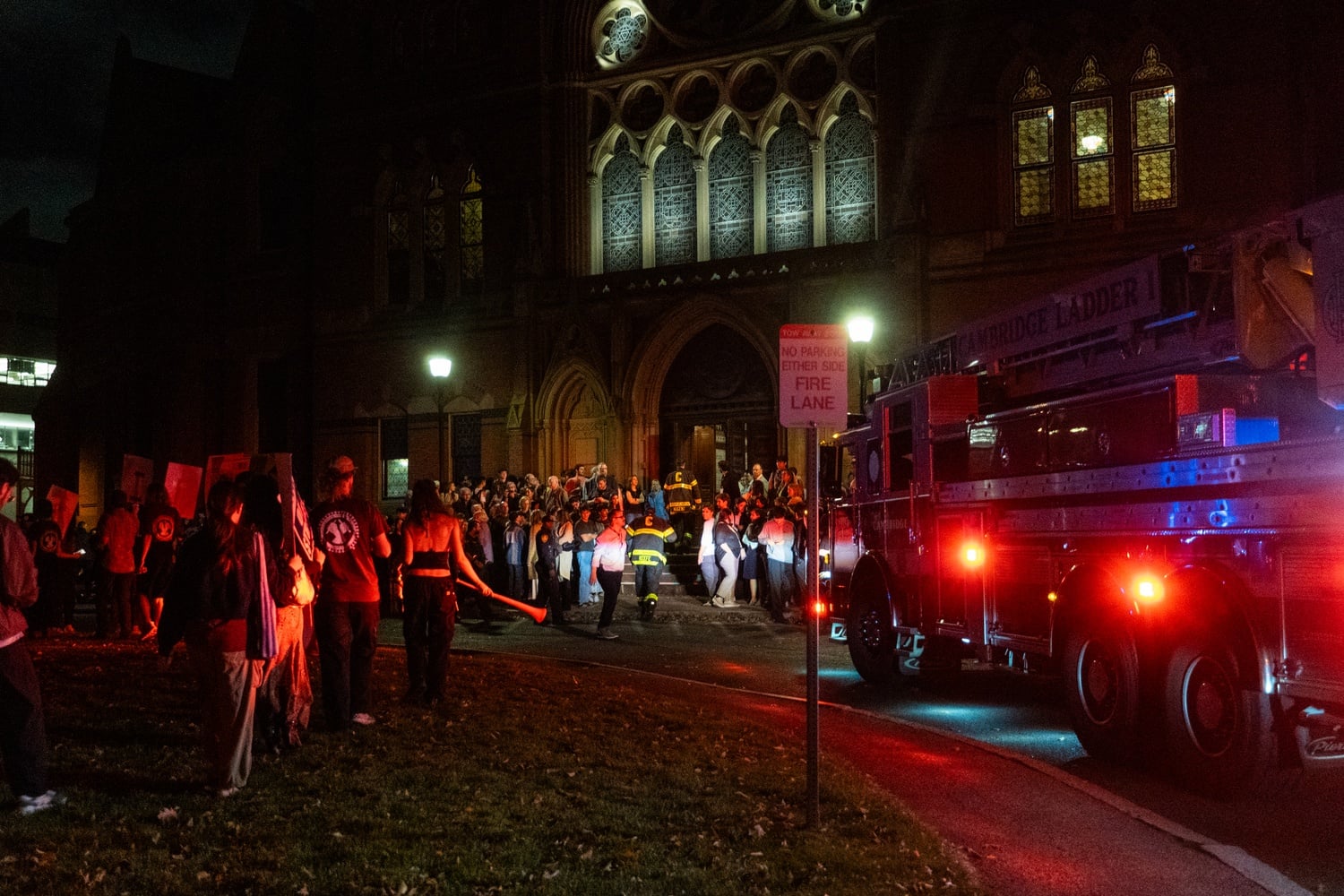
The strikers’ actions are all too familiar by now: On Oct. 29, a group of graduate students shouted into a megaphone, sounded horns and sirens, and chanted outside Emerson Hall as students took a midterm exam. One week later, strikers chanted over a sold-out panel with Yo-Yo Ma ’76 and Stephen Colbert, even as a false fire alarm forced attendees to evacuate the venue.
As the Editorial Board correctly notes, any strike action by teachers necessarily disrupts students by taking their instructors out of the classroom. It follows that those who sympathize with the graduate student union’s demands and believe all other avenues for realizing those demands have been exhausted will accept this disruption as unavoidable.
But by going beyond this incidental inconvenience and intentionally disrupting students and community members who have no power over their contracts, the strikers go too far.
The union cannot justify such direct harm to non-negotiating third parties. Those who see education as the product of the University, and thus any disruption to the educational function as legitimate, overstep. Certainly, graduate students may refuse to hold sections or grade work. But they cannot impede an educational function — like the administration of an exam — that they themselves do not provide.
My dissenting colleagues on the Board ask for a principle that vindicates graduate student picketing but forbids disrupting an exam. I offer them a simple answer: Withholding one’s own labor is permissible; taking hostages in the hope the University picks the well-being of its affiliates over its interests is not.
Instead, the dissenters, much like the union itself, cannot even bring themselves to say that disrupting an exam is wrong. (Not to mention an exam in a course where the professor, in his support of the union, tried but failed to find another location to avoid conflicting with a picket line.) But to be morally consistent, must we really believe that all disruption — barring “harassment, physical aggression, and discrimination” — is made alike?
No. There is a difference between abandoning functions to which strikers are integral, and impeding those in which they normally play no part.
Indeed, the panel episode surely dispels any notion that the strikers seek only to disrupt the educational function. Rather, the union seems committed to making the undergraduate experience in general more unpleasant for the duration of the strike.
But, supporters of the union may argue, it’s necessary to impose inconvenience on third parties in order to build support for the cause.
This is mistaken. Intentionally aggrieving students by disrupting exams and campus life in order to increase pressure on the administration is an unacceptable form of coercion. The ends don’t justify the means. “If you just give me the money, the hostage won’t get shot” is not a logic suited to members of the University.
Regrettably, it seems as though some faculty have responded by pushing the University to resolve the strike and thus end its disruptive tactics. I would implore them and other affiliates to leave the obligation of ending those disruptions with those responsible — the strikers themselves. We should allow our moral convictions to guide our actions, not sacrifice them on the altar of seeming expediency.
And, as a practical matter, such a strategy may have the opposite result. While inconvenience is no basis to change one’s view of what a fair contract looks like, it is entirely legitimate for students to lose sympathy for a strike that is excessively disrupting their college experience. Indeed, this appears already to be the case: If student activity on Sidechat is any indication, these tactics quickly soured campus public opinion against the union.
None of this is to say that the union’s demands are invalid. One can, and indeed must, hold principled views on both the nature of a fair contract and the means employed in negotiating it. My opposition to the strike, owing to the brazenness with which it has treated students, doesn’t at all subtract from my profound appreciation of our academic workers, or from my view that they ought to be compensated in a manner that allows them to live with dignity.
I continue to recognize the right of student workers to leave the classroom, but I refuse to be held hostage.
Michael Isayan ’29, a Crimson Editorial editor, is a double concentrator in Government and Economics in Cabot House.
Want to keep up with breaking news? Subscribe to our email newsletter
Have a tip for The Crimson? Share it confidentially