From Fenway’s First Pitch to The Game: Harvard’s Century-Long Connection to Boston’s Ballpark
Harvard baseball played against the Red Sox in the first-ever baseball game at Fenway Park. Now, 114 years later, the Crimson is returning to Fenway, but this time its football team will take on the Yale Bulldogs in the 142nd playing of The Game.
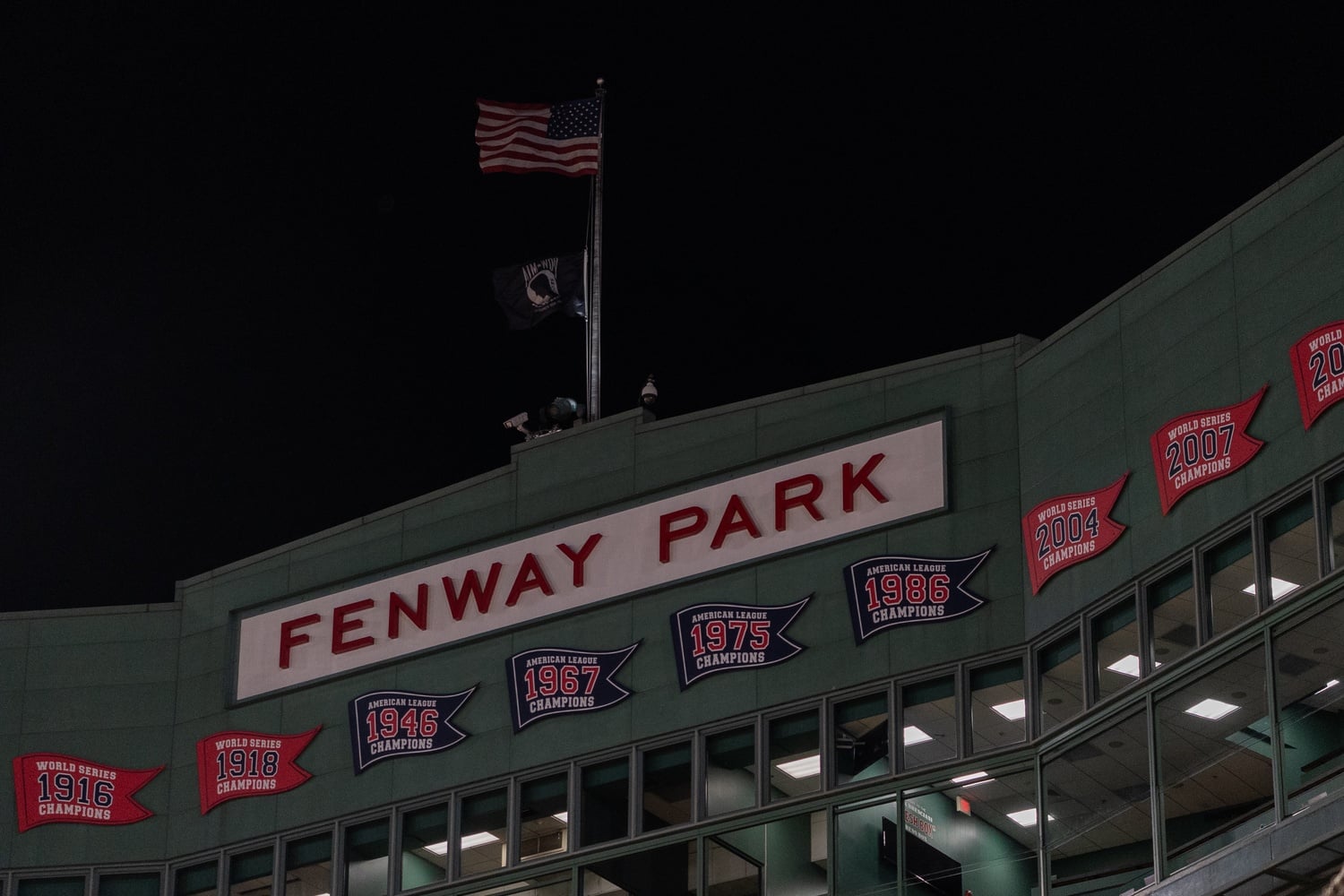
On April 9, 1912, Harvard sophomore first baseman Dana Wingate ’14 stepped into the batter’s box at a ballpark that had yet to host a major league game. Defending the diamond were the Boston Red Sox, preparing for another season in the American League. The stadium was new, its story in baseball history still unwritten, and that afternoon’s exhibition matchup against the Crimson became the first baseball game ever played at Fenway Park.
That afternoon, the Red Sox defeated Harvard 2-0. Eleven days later, Boston played its first professional game at Fenway, beginning a relationship between the franchise and its home that has lasted 114 years.
The Red Sox went on to christen the new stadium with a title in its inaugural season. The Crimson returned to Fenway to face the reigning World Series champions in 1913. The two staples of Beantown met one more time in 1916, after another Red Sox title. This time, however, Harvard earned a surprising 1-0 victory in the exhibition.
The franchise’s tradition of facing local college teams continued into the modern era, as Boston plays Northeastern and Boston College during spring training.
On Nov. 21, Harvard will return to Fenway Park, but this time, its football team will face Yale in the 142nd edition of The Game.
The battle will be the second clash between the Ivy League rivals at Fenway. In 2018, the Crimson defeated the Bulldogs 45-27 in front of 34,675 spectators.
Before relocating to their modern-day stadium, the Red Sox had played at the Huntington Avenue Grounds – a mostly wooden ballpark in Roxbury, Mass., that held roughly 11,500 spectators – since the franchise’s founding in 1901. There, the Red Sox, then known as the Boston Americans, won the first-ever World Series in 1903 over the Pittsburgh Pirates in eight games. Fenway gave the team a much larger home.
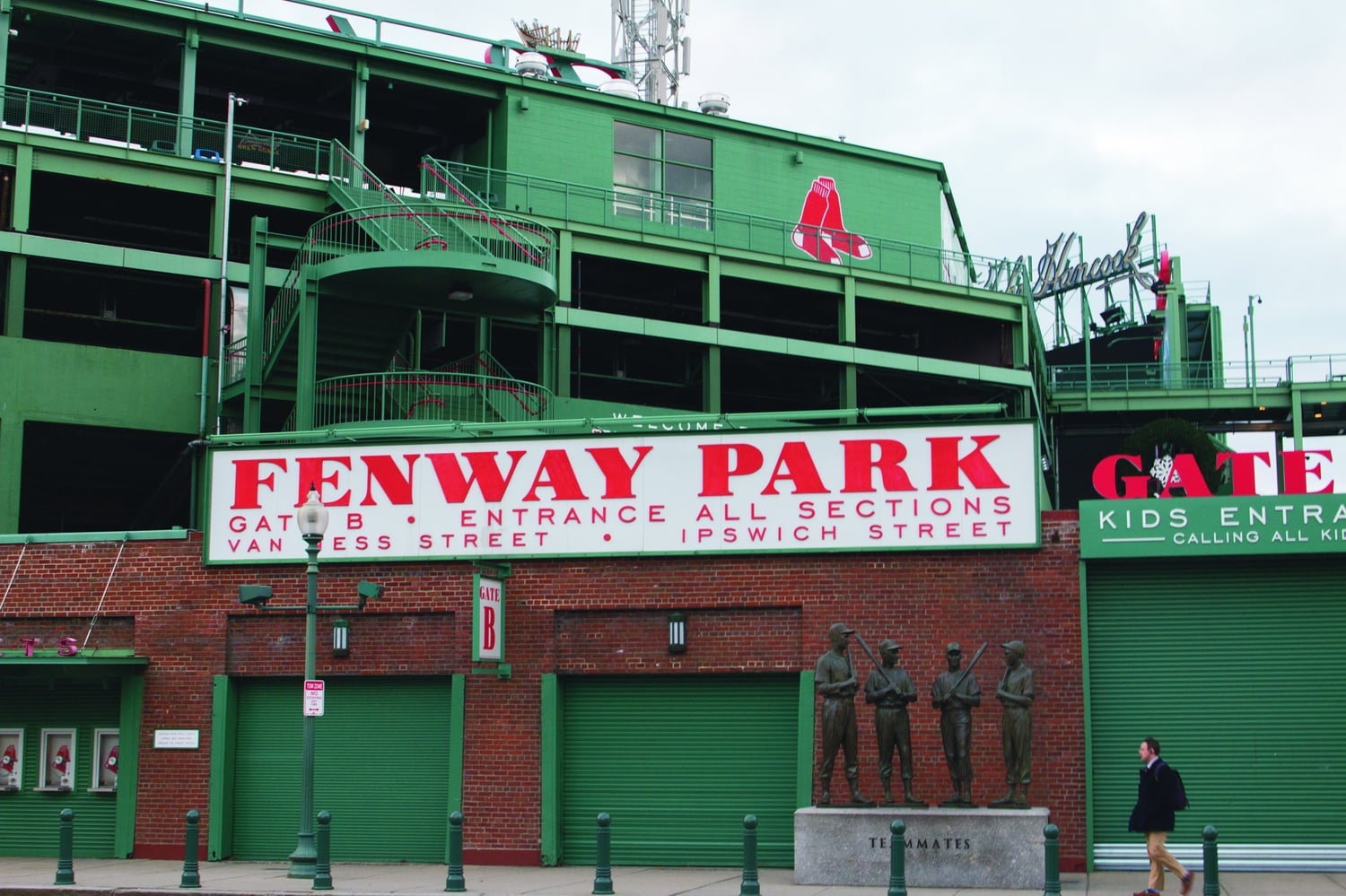
Built with steel and concrete, the new park was designed to accommodate tens of thousands of spectators while fitting seamlessly into the irregular streets surrounding the property. The street constraints helped produce the unusual dimensions that have since become an integral part of Fenway’s identity.
Squeezed between Lansdowne St., Jersey St., and Van Ness St., the park’s grounds produce a small left field, necessitating a high wall that has since become one of baseball’s most famous landmarks.
Now 37 feet tall, Fenway’s Green Monster stands just 310 feet from home plate, while the right-field foul pole is 302 feet away, the shortest distance in MLB. The tall left-field wall can turn a would-be home run into a double, even as the short right-field line rewards batters who hit the ball toward the pole.
One of the early hitters who utilized the short distance to the right foul pole was Johnny Pesky, a player and later manager for the Red Sox who is now best known for his namesake in what has become one of baseball’s famous landmarks: the Pesky Pole.
The park’s irregularities have shaped countless baseball games, but they also help explain why staging a football game there requires an entirely different approach.
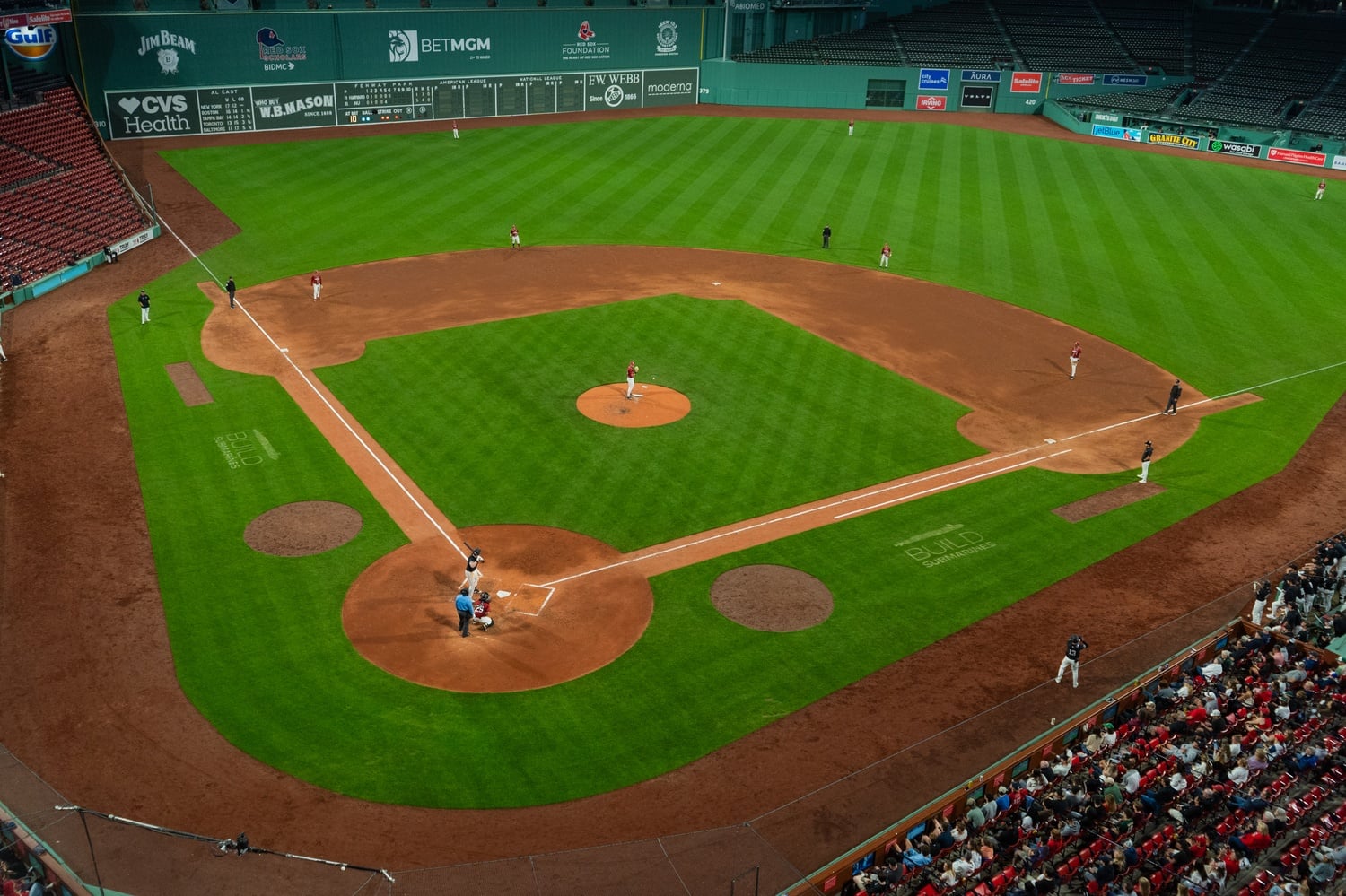
Fenway was built for baseball, and preparing it for football requires covering portions of the infield with temporary sod. In 2018, the grounds crew removed the pitcher’s mound and laid sod over the dirt, creating a gridiron stretching from the third-base line to the right-field wall. The bullpen walls were removed to give players additional space beyond the end zone.
Football arrived at Fenway in its opening year. On Thanksgiving Day in 1912, Boston Latin School defeated The English High School of Boston 7-6. Two years later, Boston College beat Norwich University 28-6 in the park’s first collegiate football game.
During the 1930s, Fenway housed the Boston Redskins, the NFL franchise that later moved to Washington, D.C. The Boston Yanks, another NFL team, played at Fenway during the 1940s before relocating to New York.
The Boston Patriots of the American Football League played at Fenway from 1963 through 1968, a run that featured the franchise’s lone playoff victory until its 1985 Super Bowl trip.
After the Patriots left, Fenway did not host a football game for decades. The sport finally returned in 2015, when Notre Dame defeated Boston College 19-16 in the Shamrock Series.
In 2022, the ballpark became home to the Wasabi Fenway Bowl, adding postseason college football to its annual calendar. In total, 11 college football games have been played at Fenway since the 2015 Shamrock Series, including Harvard and Yale’s 2018 matchup.
When the Crimson and the Bulldogs first clashed at Fenway in 2018, they brought a rivalry that was already 143 years old into a stadium that had stood for just 106 years. It was the 135th meeting between the teams.
The two schools first played football against each other in 1875, making The Game one of college football’s oldest traditions. The matchup typically alternates between Harvard Stadium, which opened in 1903, and the Yale Bowl, completed in 1914.
When Harvard Stadium was undergoing restoration work in 2018, the rivalry matchup was relocated to Fenway Park. The decision created a rare opportunity to stage the contest at a neutral venue, marking the first meeting between the two programs at a neutral site since 1894.
That 1894 game, played at Hampden Park in Springfield, Mass., sparked a national conversation about player safety in football, which at the time used meager protective gear and dangerous plays like the Flying Wedge, reminiscent of a rugby scrum.
That meeting of The Game came to be known as the “Hampden Park Bloodbath,” as it ended with at least five players hospitalized for injuries – one even falling into a coma for several hours. The schools agreed to suspend The Game for two seasons in response to the violence and did not play at a neutral site again for nearly 125 years.
In the 2018 matchup, Harvard senior quarterback Tom Stewart, playing through injury, threw for 312 yards and three touchdowns, leading the Crimson to a 45-27 victory. Harvard scored 17 points in the fourth quarter, and its 605 yards of total offense set a rivalry record.
The 2026 relocation has had mixed reception on campus. On a typical Harvard-Yale Saturday in Cambridge, students and alumni gather around Harvard Stadium, filling the surrounding area with tailgates and reunions. The matchup is as much an annual gathering of the two universities’ communities as it is a football contest.
Fenway seats more than 37,000 for baseball, compared with the 25,000 capacity Harvard Athletics lists for Harvard Stadium. The 2018 game drew 34,675 fans. At Fenway, the football field runs from the third-base line toward right field, leaving some spectators looking diagonally across the gridiron rather than directly toward a sideline.
In October, The Crimson’s Editorial Board criticized the move over transportation, safety, and the loss of traditional tailgates. In a dissent, two opinion writers argued the rivalry could retain its traditions while giving students a unique chance to experience The Game in Boston.
In 1912, Harvard baseball players entered a newly constructed Fenway Park before the Red Sox had even played their first professional game there. More than a century later, the Crimson’s football team will return to a ballpark that has become one of the most enduring landmarks in American sports.
Since Wingate’s first at-bat, Fenway has hosted World Series games, professional football, outdoor hockey, concerts, and college bowl games. On Nov. 21, Harvard will return to the ballpark it helped open, transforming the baseball diamond into a gridiron once more.
Want to keep up with breaking news? Subscribe to our email newsletter
Have a tip for The Crimson? Share it confidentially