At OFA Panel, Hoon Lee ’94 and Zoe Kazan Discuss ‘East of Eden’ and Asian American Representation
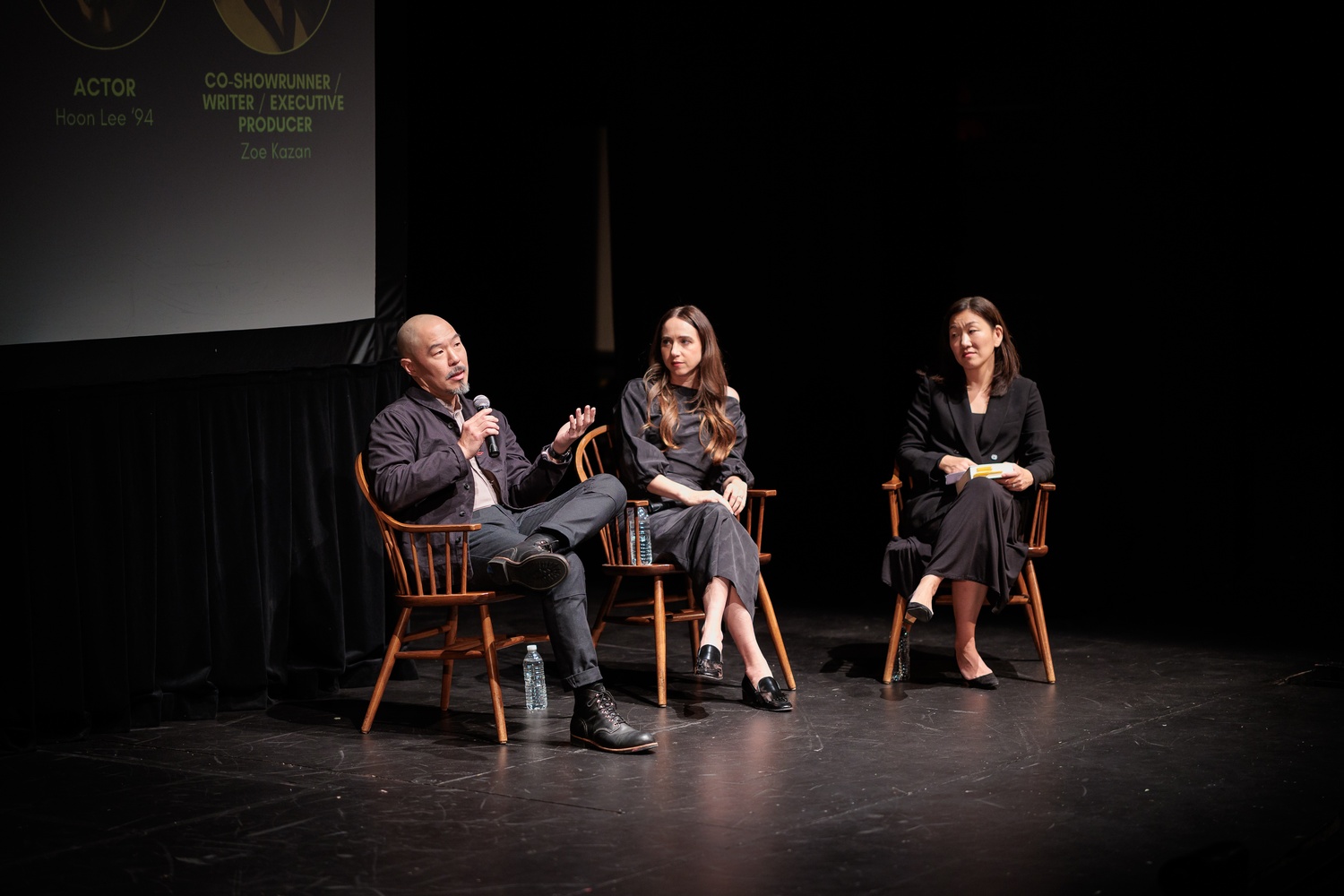
“If you’re of a certain ethnicity, raised in a completely different context from where your parents came from, you’re constantly living example of nature versus nurture,” said actor Tong “Hoon” Lee ’94 about how his performance playing Lee in Netflix’s 2026 adaptation of John Steinbeck’s “East of Eden” relates to the novel’s most prominent themes.
On Oct. 6, inside a stage-lit, red-walled Farkas Hall and in front of an audience of Harvard and Boston-Cambridge community members, former Eliotite Hoon Lee joined show creator Zoe Kazan in a panel co-organized by the Harvard Foundation and the Office for the Arts at Harvard. As moderator, Professor Ju Yon Kim, guided the event, titled “A Conversation on Reimagining American Classics and Asian American Representation on Screen.”
The panel was structured with three clips from the series, which Kazan and Hoon Lee broke down and connected to anecdotes from their own lives. Following the scenes, the team walked through several deliberate choices they made in adapting “East of Eden.”
As a key supporting actor in the new series, Hoon Lee plays the Trask family’s live-in help, who becomes a surrogate father to Adam Trask’s children after his wife violently departs their lives.
“I have the sense that I rarely — if ever — have had, that there was such a connection to his character that, if I just got a shot at it, I just knew it would take every part of me, [and] I would put every part of me to it,” Lee said about the script.
The story was formative for Kazan, whose grandfather, Elia Kazan, directed the 1955 film adaptation. It affected her coming-of-age as it did for many readers.
“I read this book for the first time at 15, and I think in the way that only can happen to you when you’re very young, this book became a part of my being. It became a foundational text for me,” said Kazan.
Kim was similarly moved by Steinbeck’s novel, particularly for its representation of the immigrant experience of conforming through language and appearance. When the supporting character Samuel Hamilton, a first-generation Irish American, presses Lee about why he still speaks pidgin rather than assimilating, he replies in perfect English, showing that he has worn a mask for the comfort of others.
“You’re going to see a moment now, that in the book made my jaw drop because I did not expect this twist. And then to see [Lee] bring it to life kind of brought me to tears because it was so beautifully done” Kim said.
Kazan was strategic in her introduction of this twist.
“The first time you see Lee, he’s reading this book and brushing his teeth at the same time, which is a thing that I used to do when I was a kid, and I get toothpaste all over my book. I just wanted the audience to have a little inside knowledge into his private world before we heard the pidgin English come out of his mouth,” she said.
Referring to Steinbeck’s own intention for the novel,
“He’s writing about his maternal family line. He’s writing about himself. He’s putting himself, the bits of himself into each of these characters, and I was really trying to honor that,” Kazan said.
But for Lee, honoring a book doesn’t mean appealing to every interpretation. Lee compared any film or TV adaptation of a book to an “orchestral score inspired by the book.”
“It’s because the material is so dear to us, because it integrates with us, because it activates the power of our own imagination, the world-building that we do ourselves, that we become protective of it,” Lee said.
This imagination in reading shows most clearly in a line that didn’t make it into the show. Kazan shared why she omitted Lee’s iconic line, “Now that you don’t have to be perfect, you can be good,” which has since found its way to magnets, posters, and jewelry. She cautioned herself against overintellectualizing or abstracting the character, to be what Lee called just “sound bites of wisdom.”
Another choice in the adaptation lets the camera show what words cannot. A play on lighting allows certain shots to subtly hide Lee even when he’s in the background. Adam says to his son Cal, “You’ve only ever had one” about fathers, while Lee watches from the darkness behind the doorway. Although Lee raised Adam’s children with daily love and care, he remains part of the family in feeling but never in recognition.
“In the spirit of what you learn through omission, because you never see the kids treat Lee as anything but a parent, we understand the relationship,” Lee said.
Certain moments in that bond are inspired by Kazan’s own experience with her caregiver, Margarita.
“So that love is in this, and I needed no stretch of the imagination to legitimize Lee as a member of this family, and also to understand in some complicated way that he will never be a member of this family,” Kazan said.
In Kazan and Lee’s on-screen interpretations, Lee becomes more than a symbol in an American classic: he becomes a three-dimensional character, defined by what he gives rather than how he is labeled.
—Staff writer Liam J. Kralik can be reached at [email protected].
Want to keep up with breaking news? Subscribe to our email newsletter
Have a tip for The Crimson? Share it confidentially