Artist Profile: Yo-Yo Ma ’76 and Stephen Colbert Would Rather Ask the Questions
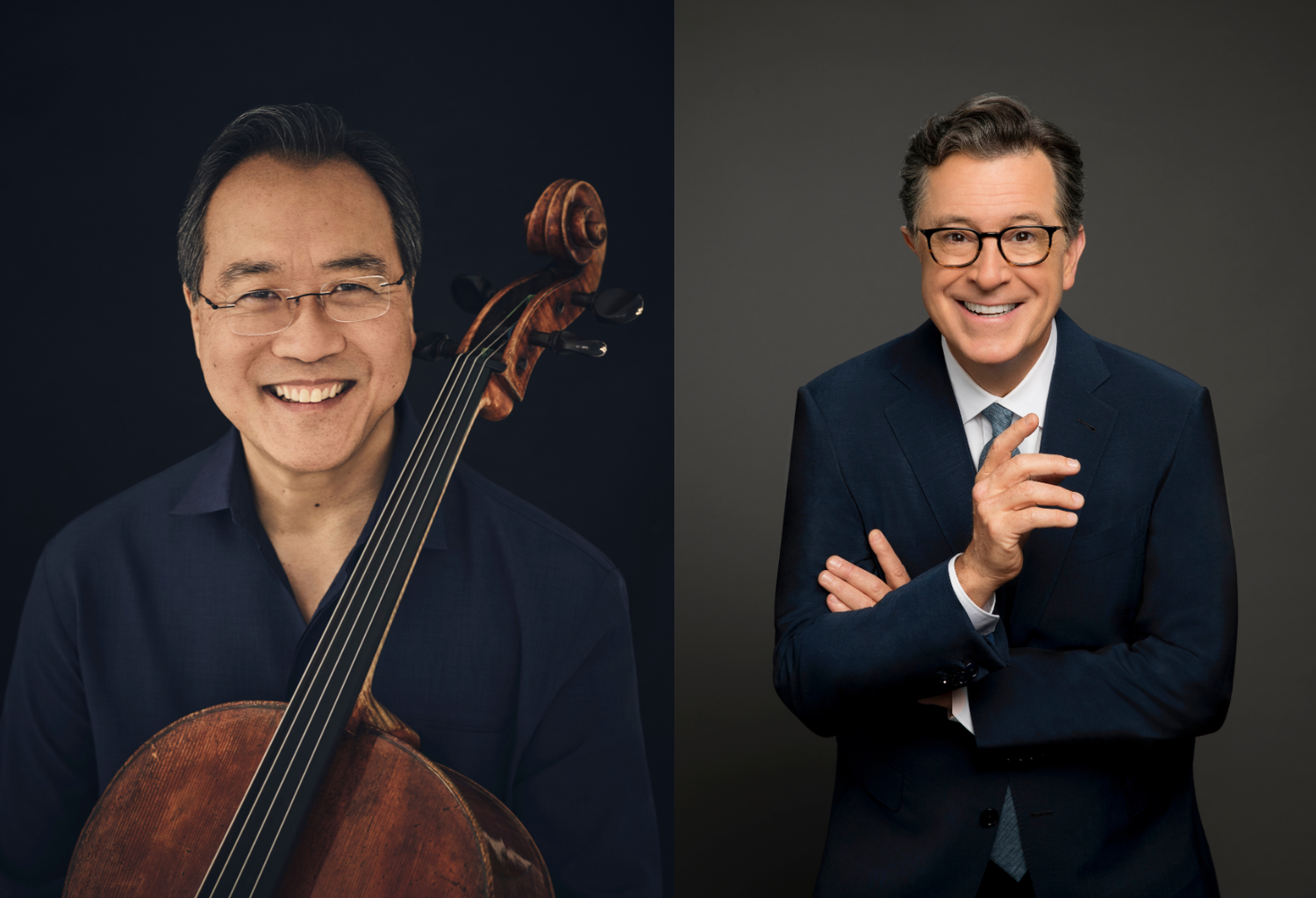
Stephen Colbert has a question for Yo-Yo Ma ’76. Ma describes his undergraduate self as “unconscious” — he “was just not aware,” he said, and picked courses that “looked interesting” without knowing much about anything. Colbert wants to understand how someone with such an extraordinary childhood could feel so unprepared for college.
“Do you think you were more unconscious than the other students there?” Colbert said in an interview with The Crimson.
Ma’s answer was “Absolutely.” His recollection of his time at Harvard opened a conversation about the demands of childhood, their parents’ pasts, and the different ways they learned to pay attention.
Ma has recorded more than 120 albums, 20 of which have won Grammy Awards. Colbert, whose Emmy-winning “The Late Show With Stephen Colbert” aired its final episode in May after 11 seasons, has learned that interviewing Ma means fielding questions back.
“It’s very hard to interview Yo-Yo because he keeps asking you questions back, and maybe a better question that you asked him,” Colbert said.
Born in Paris in 1955, Ma began studying the cello with his father at four and moved to New York City at seven.
“I was an immigrant. I lived at home until I went to college, and it was a pretty hot house environment. It was sequestered,” Ma said.
Ma grew up between competing cultures — France, the United States, and China. Harvard, which he entered at 16, became “an escape valve.” At Harvard, he met two friends who constantly mocked his attempts at jokes and taught him about friendship.
In his senior year, Ma walked past one of the college libraries with his roommate and saw how much of his time at college he had let pass.
“It was a sad moment of realization, but it actually made me conscious of saying, ‘Okay, you now hold all of these things in your head, and what are you going to do about it?’” Ma said.
Colbert, on the other hand, described himself as a “sad young man” who put his misery on display.
“I didn’t want to play Hamlet,” Colbert said. “I wanted to be Hamlet.”
Colbert, the youngest of 11 children, was 10 when his father and two of his brothers died in the September 1974 crash of Eastern Air Lines Flight 212. He later spent two years studying philosophy at Hampden-Sydney College in Virginia.
“I threw myself into philosophy because my father, who had died when I was quite young, read philosophy for pleasure,” Colbert said.
After “two years in the desert,” Colbert transferred to Northwestern University in 1984 to study theater. In Chicago, a troupe that improvised one-act plays at a small club entranced him, and improvisation soon became his art form, his circle of friends, and his philosophy.
Ma’s parents lived through World War II, and he has spent his life “trying to figure out what happened.” Colbert assumed Ma meant his family.
“What happened with them in World War II?” Colbert asked.
“Or what happened in the world?” Ma replied.
Both, it turns out. Ma’s parents rarely talked about the war, but his father lived through the Japanese invasion in China and the Nazi invasion in Paris. The question Ma keeps asking is why people can be so cruel to one another. He keeps returning to an old line: “One death is a tragedy; a million deaths is a statistic.” Ma wants nothing he does to become a statistic.
Colbert seized the word and turned it toward artificial intelligence. Like Ma, he wants to avoid adding to “that statistical perception of humanity,” he said — and large language models are mathematical.
“Within the base of it, the response to you is a statistical response. And I’m just curious,” Colbert said. “I keep on saying to myself, ‘I wonder if I could behave in a way that would confuse an AI, but I would still understand, and you would still understand, but the AI wouldn’t.’”
He framed the question as a test.
“Could we speak to each other in a human code that the AI couldn’t understand because it lies outside of statistical behavior?” Colbert said.
The two didn’t meet through their work. Ma first got to know the family of Colbert’s wife, Evelyn McGee Colbert, in the late 1970s or early 1980s, by Colbert’s estimate, and Colbert came to know Ma through them — hence the first lesson Colbert draws from the friendship: “marry well.”
Ma has since appeared on Colbert’s show. In October 2015, Ma celebrated his 60th birthday there and played the courante from Bach’s Cello Suite No. 2 while Misty Copeland, then a principal dancer at American Ballet Theatre, danced. This January, he played the prelude from Bach’s first cello suite and moved into “Over the Rainbow.”
Ma’s recent projects have taken his music outside the concert hall. In 2018, he began the Bach Project, which planned performances of Bach’s six cello suites in 36 locations on six continents and paired each with a “day of action” of local conversations, collaborations, and performances. For “Our Common Nature,” now also a WNYC podcast, he has played in Kentucky’s Mammoth Cave and for whales off the coast of Hawaii.
Colbert admires Ma’s “extraordinary intimacy with the audience.” He seeks the same connection in his comedy.
“Responsibility sounds like a drag, but responsiveness to the audience is a related idea. Are you there with them, or are you there dominating them, or are you making communion with them?” Colbert said. “At best, a joke is a great form of communion.”
Ma, in turn, finds in Colbert a rare match between the public figure and the private one.
“I have to say that what Stephen [projects] both privately and publicly, is an authenticity that makes [him] such a kind of person that this campus really wants to hear from, because that is really hard,” Ma said.
Then, Ma pledged to share a life raft with Colbert, “knowing that [he’ll] push [him] over.” Colbert committed to the bit.
“Exactly. I absolutely mean it when I say there’s only enough water for one. As you go under, you go, ‘I appreciate your authenticity,’” Colbert said.
“Or you could say, ‘Thank you for your service!’” Ma replied.
For Colbert, responsiveness starts with improvisation. Chicago long-form improvisation drew heavily on mid-20th-century jazz and aims for a “discovery, not an invention.” Most people know its rule of “yes, and.” Colbert puts other principles first: “hear and be heard,” “follow the follower,” “serve the servant.”
“Who is the most important person on stage? The other person on stage,” Colbert said.
The audience counts as a scene partner, too — and, in Colbert’s estimation, the best one in the room.
“Who is the other character who is actually probably doing a better job of improvising than you are? Because the audience has no pressure to do it well, and therefore they do it perfectly,” Colbert said.
Ma hears his own discipline in Colbert’s rules: A musician, too, has to attend to someone else.
“To do that actually requires having enough mental real estate — brain real estate — to care about someone else while you’re doing something,” Ma said.
A musician builds technique “so [they] can transcend it.” Yet being a musician isn’t about delivering an agreed-upon result.
“The discovery part is to to dare to go into the unknown together with somebody and trust that you know the ball that you’re throwing is going to be caught — and if someone drops the ball, you will catch it, and it’s that amazing trust in the unknown back to the life raft when you’re going to push me in,” Ma said.
Colbert may push him out of the raft, but “[he’ll] actually pick [him] up again.”
Trust is one condition for creative work. For its source, Colbert started with J.R.R. Tolkien’s “sub-creative impulse”: Because we are made, we make. But for him, the impulse needs feeding.
“Waiting, wishing, wanting, hoping to be creative will never make you creative,” Colbert said.
Thinking might supply tools, but feeling comes first — and the first feeling for Colbert is: “I don’t want to be alone.”
Ma called the opposite of waiting, “seeking.”
“I think we’re in the business of awe and wonder, which is the ineffable,” Ma said.
Yet Ma also names a danger: Creative people can go so deep that they enter cycles they can’t leave.
“Ultimately, you want to be creative, but you also want to get out alive,” Ma said.
Colbert agreed with Ma and offered a synonym for seeking: “getting in trouble.” When Colbert was in his 20s, director Dexter Bullard would call him with the same question: “Do you want to get in trouble?” Bullard would find spaces and set opening nights for shows before he had written them.
“You must put yourself in trouble to find out what you’re capable of. Give yourself the ball,” Colbert said.
His advice to students living in a time of change is simple.
“Worry will not help. Love is the thing that will help,” Colbert said.
Ma limits how much news he takes in. People who keep television, radio or social media on “all day long” are following “a recipe for disaster.” Instead, he spends about 90 percent of his time on work he considers useful or constructive — with friends, loved ones and “fellow unicorns” — and about 10 percent following “the ills of the world.” Spending time that way means knowing “you’re not a statistic.”
“You can’t resist a tsunami because the force is too big. But you want to plant the seeds that will grow when the tsunami subsides,” Ma said.
Ma and Colbert will take the stage at Sanders Theatre on Thursday, Nov. 5, at 7 p.m. for “Arts for Life’s Sake,” part of the Office for the Arts’ celebration of 50 years of Learning from Performers.
The question about artificial intelligence awaits them there. So does an audience — which, if Colbert is right, will improvise better than anyone onstage.
—Staff writer Erlisa Demneri can be reached at [email protected].
Want to keep up with breaking news? Subscribe to our email newsletter
Have a tip for The Crimson? Share it confidentially