Advocates Urge MassDOT to Reconsider Designs for Cambridge’s Reid Overpass
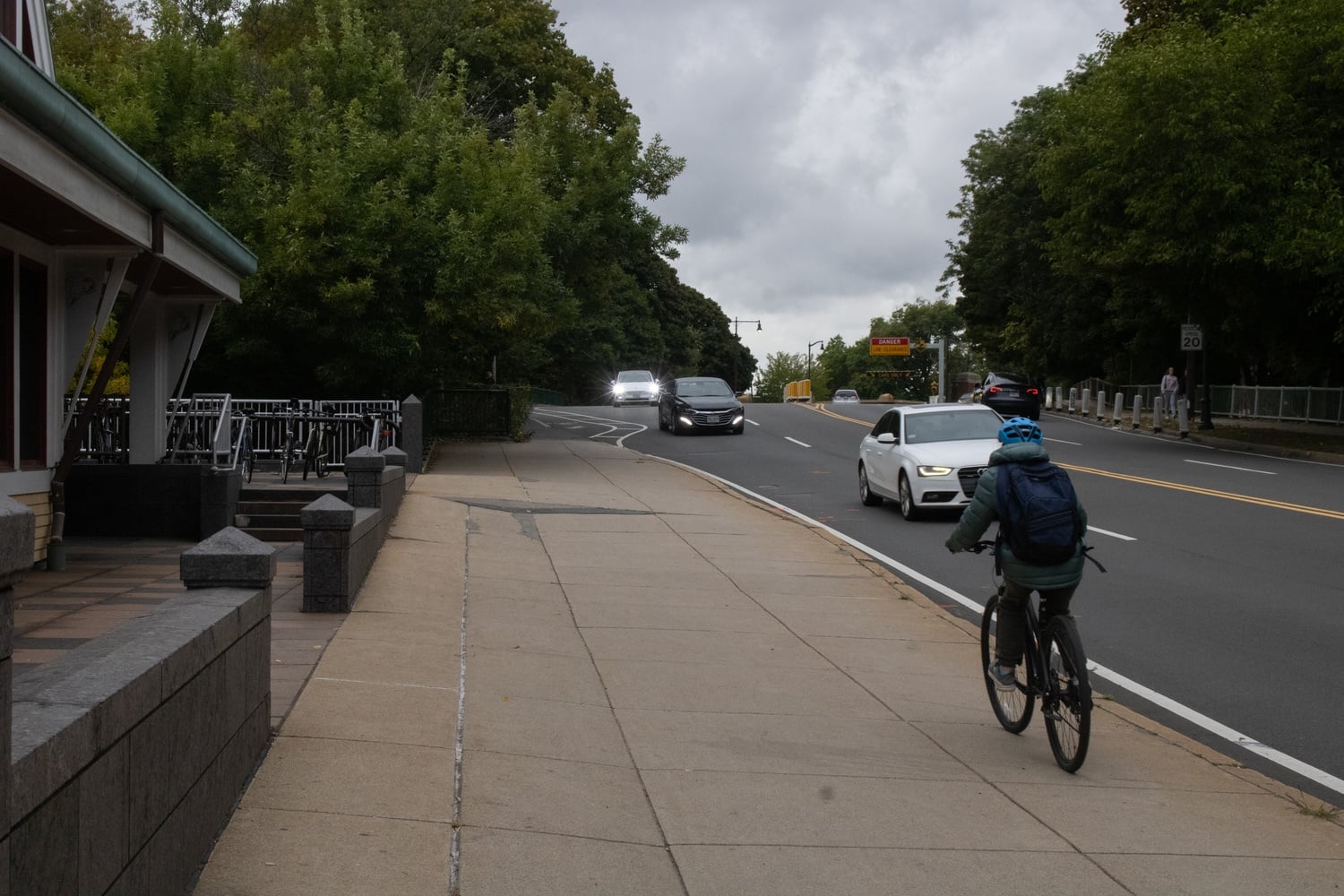
Advocacy groups across the state are urging the Massachusetts Department of Transportation to reconsider its preliminary designs for Cambridge’s William Reid Overpass, arguing the proposed plans could worsen conditions for cyclists and pedestrians at a notoriously dangerous intersection.
At a Jan. 6 public meeting, MassDOT presented four potential designs to replace the overpass, which connects Memorial Drive, Brookline Street, and the Boston University Bridge. But transportation advocates say the proposals prioritize vehicle traffic at the expense of safety — concerns that have intensified since cyclist John H. Corcoran ’84 was killed at the intersection in September 2024.
Cambridge Bike Safety, a volunteer advocacy group, has led the proposition to the current proposals, organizing a coalition letter calling on MassDOT to develop three to five additional alternatives that would not prioritize increasing the flow of vehicle traffic over public safety.
The letter was signed by several transportation and advocacy groups, including Livable Streets Alliance, Walk Massachusetts, MassBike, the BU Bridge Safety Alliance, and the Memorial Drive Alliance. Some Cambridge residents have also circulated their own design proposals.
MassDOT’s four preliminary concepts include a modified at-grade intersection, a single-point intersection with a bridge, a multilane roundabout with a bridge, and a tight diamond interchange.
Christopher A. Cassa, a volunteer with Cambridge Bike Safety and an assistant professor at Harvard Medical School, said the proposals share a key flaw: they would expand roadway capacity in a way that could encourage faster driving on memorial drive.
“People largely just follow what the cues are,” Cassa said. “If there’s straight driving with highway-sized lanes, and there are no obstacles, and the landscape is designed for driving, and it’s very visual that it’s a highway, people will drive highway speeds. It doesn’t matter what signs you put up.”
Memorial Drive’s posted speed limit is 25 miles per hour, but Cassa said drivers frequently travel well above that.
Because each of the four proposed designs adds lanes and crossings, Cassa said they risk reinforcing what he described as the “highway feel” of the corridor — even though the surrounding area is densely populated.
“When you’re designing in a dense urban environment, you don’t design a highway,” Cassa said. “You design a road that’s going to encourage safer speeds and not just be about motor vehicle throughput.”
Get The Crimson in your inbox.
Some transportation experts and residents have also proposed alternative approaches.
Peter G. Futh, a Northeastern University transportation professor, has circulated a concept that would shrink the footprint of the intersection and eliminate the large overpass, instead consolidating crossings into a more compact, signalized design.
Still, the project remains in its earliest stages, according to Massachusetts State Representative Michael L. "Mike" Connolly, whose district includes the site.
“We are still basically at a conceptual stage,” Connolly said. “So I am very grateful that there’s a lot of advocacy input and energy, and at the same time, I can appreciate from MassDOT’s perspective, that they are dutifully going through all of the feedback that they’ve received, and I know they’ve committed to continuing to engage with our advocacy groups.”
Some advocates have also expressed frustration that MassDOT declined an immediate request for another meeting with transportation groups following the January presentation.
But Connolly said the delay may reflect the agency’s effort to review feedback rather than reluctance to engage.
“It means that they are taking the time to really listen to what people have to say,” said Connolly. “And rethink perhaps some of their initial assumptions in ways that will, I think, allow us to get to the optimal design.”
Advocates for bike safety and local politicians have criticized the intersection for years, urging state departments to widen the sidewalk to give pedestrians and cyclists more space. The calls were revived after Corcoran was fatally struck by an SUV driver while biking on the sidewalk.
In a statement to The Crimson, MassDOT wrote that officials are reviewing public comments and revising the proposals accordingly.
“Based on the input we have received, we have been working to refine our concepts to integrate community feedback and enhancing pedestrian and bike accommodations and continue to look at options which include a new, smaller version of the Reid Overpass and ones which process all traffic at-grade,” MassDOT spokesperson John Googin wrote.
Construction is currently scheduled to begin in summer 2028 through the Boston Metropolitan Planning Organization’s Transportation Improvement Program.
—Staff writer Maya Fu can be reached at [email protected].
Want to keep up with breaking news? Subscribe to our email newsletter
Have a tip for The Crimson? Share it confidentially