Homeless People Displaced as Harvard Restricts Overnight Smith Center Access
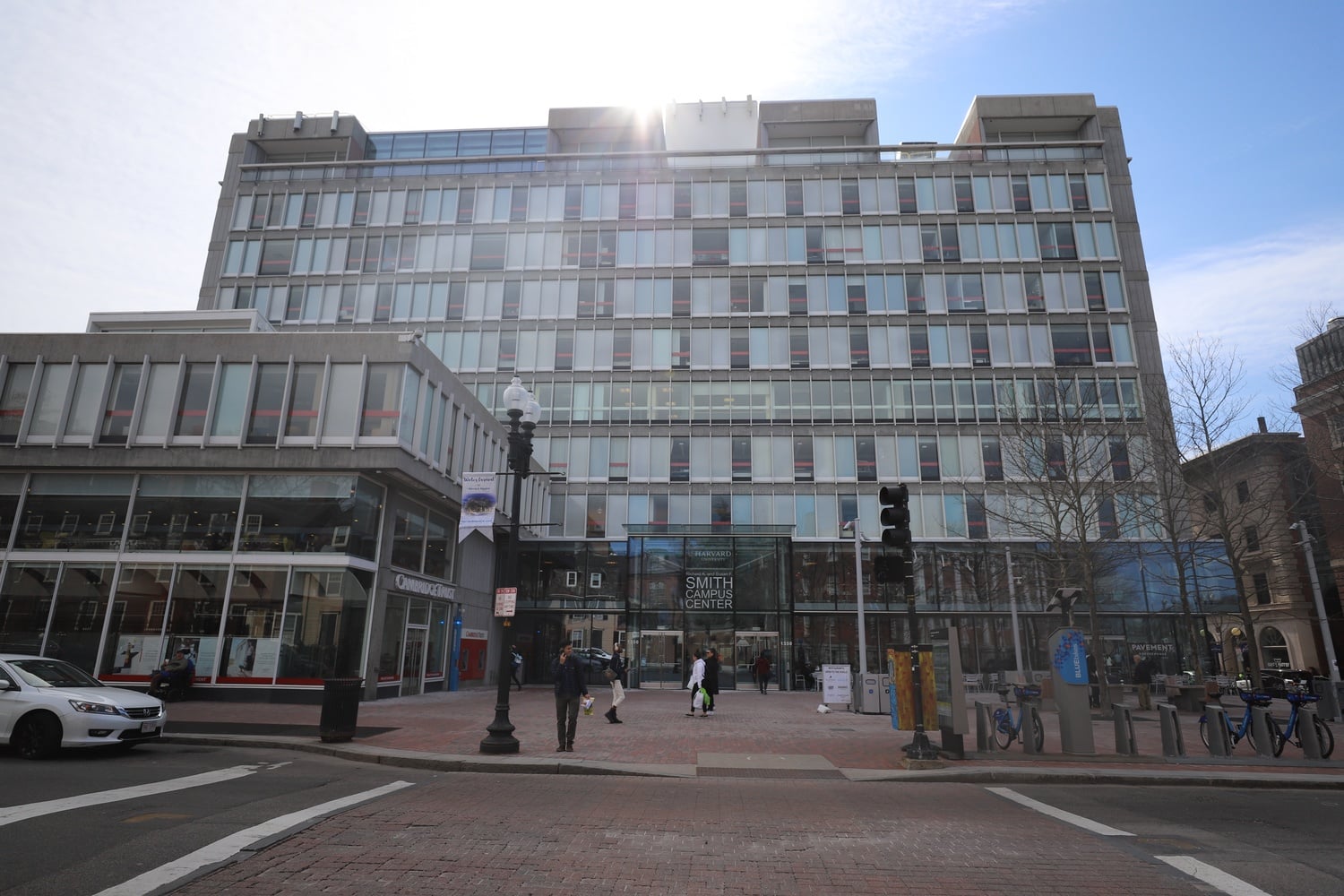
Harvard has begun restricting access to the plaza outside the Smith Campus Center outside of the building’s operating hours, displacing homeless residents who have regularly stayed there overnight.
The Smith Center plaza, which contains dozens of tables and chairs, has historically been open to the public 24 hours a day. Over the summer, however, building staff began taping off the area after the Smith Center closed at 10 p.m.
Then, in September, staff began further restricting seating on the plaza by tying the tables and chairs together, rendering them unusable overnight. Seven Cambridge residents who frequent the Smith Center plaza at night — including three who once regularly slept there overnight — said they had never before seen access to the plaza restricted overnight.
People who remain on the plaza after the Smith Center closes are told they must leave by midnight and cannot return until 7 a.m. Those who remain after being told to leave could be removed by the Harvard University Police Department or arrested if they refuse to comply.
Richard P. McLeod, a Cambridge resident who frequents the Smith Center plaza at night, said that chaining chairs together and closing the area off unfairly punishes the public.
“They’re cutting the hours, and they’re closing up the chairs, and they’re kicking out everybody instead of just taking it out of the troublemakers,” McLeod said.
Homeless residents who once slept overnight at the plaza’s tables and chairs have moved to seating along the sides of the Smith Center on Dunster and Holyoke streets, as well as benches in Cambridge Common and Winthrop Park and the entrances of local businesses, according to people who previously slept at the plaza.
Since opening in 2018, the Smith Center has served as a hub for both Harvard students and Cambridge residents. The building is one of the few climate-controlled spaces in Harvard Square that is open to the public throughout the year, and homeless people in the Square often rely on its amenities, including public restrooms, especially during the winter months.
But HUPD records show a sharp rise in enforcement activity at the Smith Center over the last two years.
A Crimson analysis of daily logs released by HUPD since 2019 — which detail incidents police responded to, along with their locations and classifications — found that officers logged 107 incidents at the Smith Center involving an “unwanted” person, alleged trespassing, or disorderly conduct in 2025, a record high.
Get The Crimson in your inbox.
Of the 33 arrests HUPD has made at the Smith Center since 2019, 12 occurred in the first nine months of 2026, records show. In five of those cases, HUPD logs described the person arrested as homeless.
Harvard police have also issued 29 trespass warnings at the Smith Center so far this year, compared to 30 in all of 2025.
HUPD spokesperson Steven G. Catalano wrote in a statement that the department “is committed to maintaining a safe and secure campus through quality policing while treating all individuals with dignity and respect.” He did not respond to detailed questions about trends in HUPD’s enforcement at the Smith Center.
Local organizations, meanwhile, have continued to connect homeless residents of Harvard Square with social services.
Cambridge’s Community Safety Department helps connect homeless residents with local shelters, writes referrals for social assistance programs, and directly provides homeless people with basic necessities. CSD also deploys the Community Assistance Response and Engagement Team, which sends licensed social workers instead of armed police to respond to certain emergency calls.
Patricia A. “Patty” Contente, an assistant director of clinical services at CSD, described the “crackdown” at the Smith Center as “hard for community members.” She added that the fall represents a period of transition for many homeless residents of Harvard Square, as colder weather sends people scrambling to find spaces to sleep while waiting for Harvard’s two student-run homeless shelters to open on Oct. 15.
“People are getting displaced from other areas, but then they’re also waiting on the services that they do rely on to open up, so that’s why there’s more people in the area,” she said.
CARE prioritizes building individual relationships with residents to make it easier to connect them with resources.
“It’s hard when you’re out there, and you’re trying to get access to services. You have to tell your whole life story to 10 million people,” Contente said. “That can get exhausting.”
—Staff writer Shawn A. Boehmer can be reached at [email protected] and on Signal at shawnb.18. Follow him on X @ShawnBoehmer.
—Staff writer Claire A. Michal can be reached at [email protected] and on Signal at ClaireMichal.154.
Want to keep up with breaking news? Subscribe to our email newsletter
Have a tip for The Crimson? Share it confidentially