Out of the Ranks, And Into the Classroom
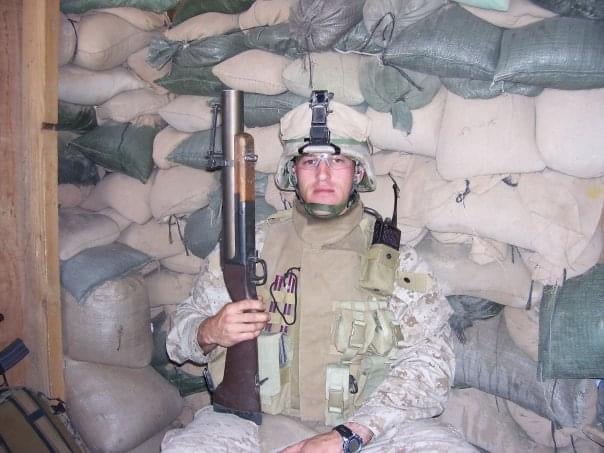
When Edward Somuk applied to college, he did so in part because he wondered, after fighting in two wars, why exactly he was “compelled” to go to war in the first place.

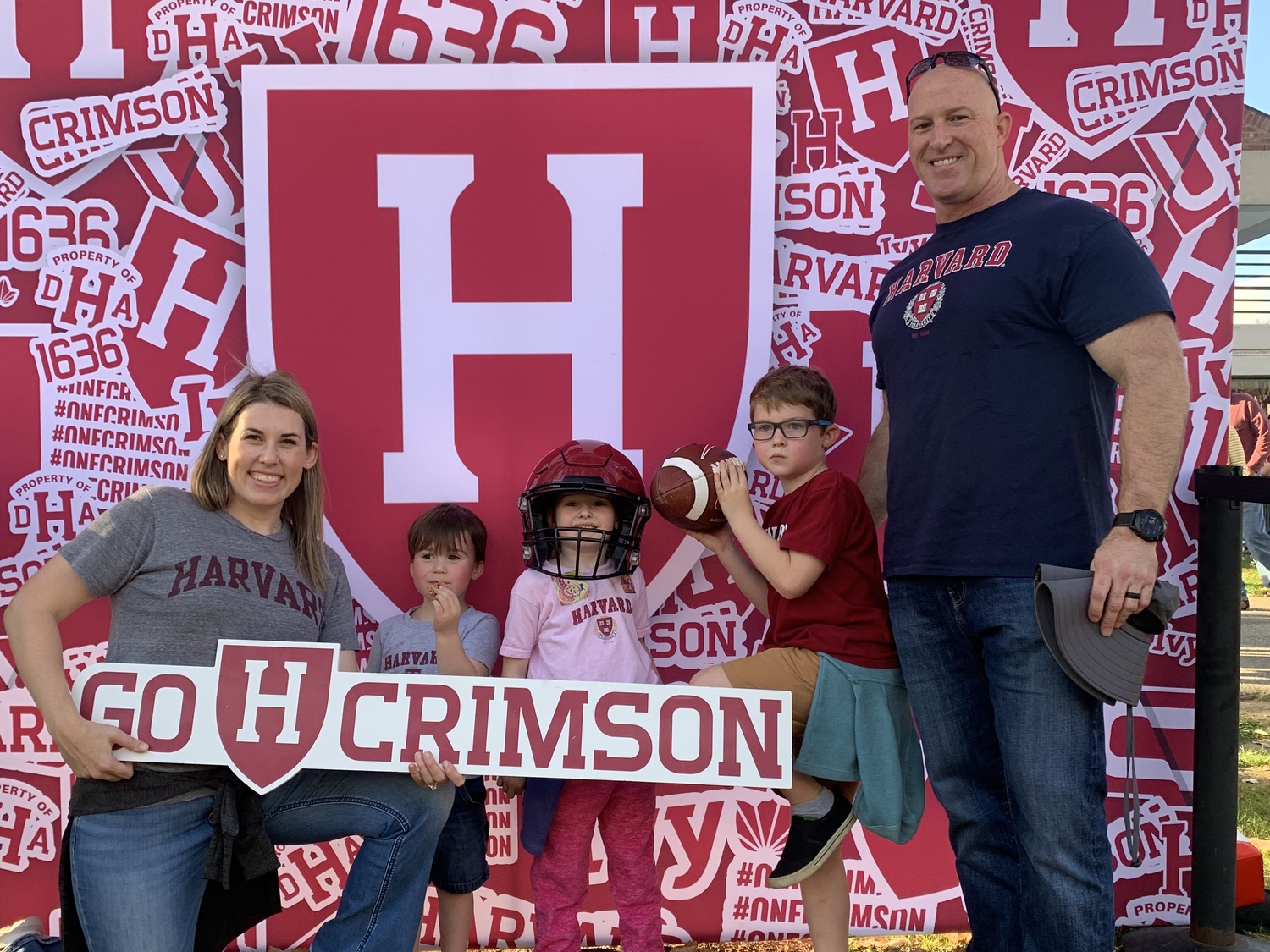
dward J. “Ed” Somuk ’27, like many Harvard undergraduates, lives and dies by his calendar. But as a Marine Corps veteran, husband, and a father of three, his calendar looks a little different from his classmates. Orange is for his classes, purple for his wife’s at MIT, and yellow is for their family’s daily activities and appointments.
Their mornings start at 6:15 a.m. on Hanscom Airforce Base. He and his wife make their kids’’ lunches, wake them up for school, and help them get ready — a routine Somuk describes as a “three ring circus.”
Somuk drives 20 minutes to Waltham, where he drops two of his three kids off for school, and then drives another 30 minutes to Cambridge. When he comes home at night, the History and Classics concentrator does his readings and takes care of his kids — a balance that often means late nights.
“There have been times when I’ve been up at midnight doing Latin because I get home and I’’ve got to do dinner with the kids and do their bed times,” Somuk says.“It’s like, okay, I’m going to be up a little bit later tonight because I need to sit down and watch this Paw Patrol episode with my six year old, because I can tell he’s been needing my attention.”
Somuk is one of many veterans now attending Harvard College — part of a recent upward trend in veteran admissions. In 2018, just eight veterans were enrolled as undergraduates at Harvard. By 2024, that number had risen to 78.
Somuk finds pursuing his degree and raising his children (now ages ten, seven, and six) to be a rewarding challenge.
“I would say, first and foremost, I have to give a lot of credit to the Marine Corps for teaching me how to function and produce when you’re exhausted,” Somuk says.
Though he is often three decades older than his peers, Somuk says he’s still made great friends since coming to Harvard.
“My bestie is on the women’s soccer team. We’ve been friends since freshman year,” Somuk says. “Every week we get together and we either have lunch or breakfast to keep in touch. I go to the games to support her and her roommates.”
***
Like Somuk, Aaron Rosales ’26 balances fatherhood and college. After eight years in the Marine Corps, he came to Harvard at the age of 30 with a wife and a child.
He acknowledged that as more veterans have come to Harvard, the University has had a process of “growing and learning” as it’s adjusted to the needs of the expanding veteran population. Though Harvard was able to bridge the financial gap for him, Rosales says his first year was challenging because he had to live in University dorms.
“You’re in the dorms with a bunch of 18, 19 year olds, and being the old man on the floor, it’s almost like going through boot camp again,” he says.
For Rosales, balancing being a father and a student has often meant wearing both hats simultaneously. He says he makes sure to take his daughter to at least one of his classes each year to remind her that, even if she changes her mind once or twice, she can still pursue whatever she wants in life.
“I’ve made it a point to take her to a class, showing her, ‘Hey, Dad did a career change and decided to go back to get his education at one of the best universities in the country, let alone the world. If I can do it, you can do it,’” Rosales says.
Now as a senior, Rosales says that the College is “much better” at accommodating veterans than when he began.
“We have veterans now that are married showing up with their wives and kids that are staying off campus, and they’re able to access the GI Bill. They’re able to access housing through university, through the lotto system,” Rosales says.
Like many veterans, Rosales applied to Harvard after connecting with two non-profits: — Service to School and the Warrior-Scholar Project.
Service to School provides veterans with application support, college counseling, and mentorship, and the Warrior-Scholar Project helps veterans transition from the military to higher education through programs like academic boot camps at universities around the country.
Harvard became officially affiliated with the Warrior-Scholar Project in 2014 and Service to School in 2017. This affiliation allows the College to connect with and recruit talented veterans transitioning to civilian life. All of the veterans The Crimson spoke to for this piece participated in one or both programs.
Rosales attended a virtual college fair organized by Service to School. He went to the event to ask a Harvard’s admissions officer questions on behalf of one of his friends. Even though Harvard had been a dream school for Rosales, he hadn’t considered applying.
After asking the admissions officer all his friend’s questions, the admissions officer said that he thought Rosales would make a great candidate. Rosales credits him with convincing him to apply and says that the admissions officer “really made such a huge impact.”
***
Ed Somuk says his classmates are often unsure how to ask him about his experience in the Marines. He has noticed that the media’s depiction of PTSD and war has drawn lines that peers are reluctant to cross.
He now starts seminars by explaining his experiences and reassuring his classmates that five decades of life experience and 26 years of military experience don’t mean he is going to discount their perspectives. He feels that problems like climate change, social media pressures, school shootings, and college debt are all important issues that are unique to the generation sitting across from him in section.
At the same time, he urges classmates to reach out to veterans to learn about their experiences.
“If you want to get a perspective from someone who’s done something a little off the beaten path from the majority of the students here, reach out to a vet. You find that we’re very open to talking and very open to sharing,” Somuk says.
He argues that the lived experience of veterans directly applies to the timely topics being batted around on college campuses.
“Just keep in mind that a lot of us, we didn’t just read about it. Some of the history that’s going down right now – we’ve kind of lived some of this stuff,” Somuk says.
In many ways, James N. Pippin ’28 has lived some of the world’s most recent history. In his four and a half years in the Army, he helped process refugees from the United States’ withdrawal from Afghanistan and sat on the border between Slovakia and Ukraine with a NATO battle group during Russia’s invasion of Ukraine.
Pippin joined the army after dropping out of high school and completing his GED. He took community college classes while serving with the Second Cavalry Regiment in Germany. When he came to Harvard, he was concerned about what he would encounter in the classrooms. In the end, he says he didn’t have too much trouble transitioning to life in Cambridge.
“I was kind of worried when I got in that opinions would be unrefined — that people would be obnoxious or disrespectful. But it really turned out to be the opposite,” Pippin says.
Thomas “Tom” Nelligan ’27, a Social Studies concentrator currently studying abroad at Jesus College at The University of Cambridge, thinks that veterans bring important nuance and intellectual diversity to classrooms at Harvard and elsewhere.
“I think being in the military is a great addition to Social Studies classrooms, because a lot of what Social Studies is talking about is these social forces that are affecting the world,” Nelligan says. “And if you’ve been in the military, you are in what’s called a totalizing institution — it controls every aspect of your life. And so, not only do you understand exactly what it’s talking about, you’ve probably lived through some of these things.”
But Nelligan has also noticed that having an outlook on life that can feel distant from that of his peers can be difficult to navigate. “You definitely feel like a fish out of water,” Nelligan says.
Nelligan says that it can be hard to come to college at an age much older than his peers. Still, Nelligan credits the rugby team, the First-Year Outdoor Program, and Harvard’s radio station, WHRB, with helping him find community at Harvard.
Nelligan also found a place in the Harvard Undergraduate Veterans Organization, where he previously served as president of the group.
Rosales has been a member of HUVO since his freshman year and says that the group has “grown tremendously” over his time at Harvard. He has seen the community develop new networking opportunities and support systems for veterans transitioning to undergraduate life at Harvard.
Vanessa E. Valverde ’27 is a Marine Corps veteran and current president of HUVO. She says that the sharp rise in veterans has reshaped how HUVO serves veterans on campus.
“HUVO itself has seen our own mission change and develop, and the expectations that veterans have for us now in the club has grown in the best way possible, because when you’re serving, you know, less than 10 people, there’s kind of not really much you can do,” Valverde says.
HUVO supports incoming and current veteran students as they navigate classes, housing, and career plans. They also help build a support network among faculty and alumni. For instance, Valverde says the group has been advocating for a dedicated veteran representative at the Mignone Center for Career Success who can help translate veterans’ experience to the civilian job market.
She says that in addition to their work on behalf of veterans, HUVO is there to help bridge the gap between veterans and the rest of the Harvard community.
Harvard has had a long relationship with the military. During World War II, Harvard became a center for U.S. defense research and training. After protests against the Vietnam War, the Faculty of Arts and sciences cut official ties with the Reserve Officer Training Corp. Though students could participate at MIT, the College did not officially recognize ROTC again until the end of the “Don’t Ask, Don’t Tell” policy.
Rosales is reminded of veterans’ legacy at Harvard when he sees the spaces on campus dedicated to them — places like Memorial Hall, lined with the names of Havard alumni who gave their lives in the Civil War. But, he says, sometimes those symbols can feel hollow.
“Sometimes it feels like a bumper sticker, like, ‘Hey, thank you for your service.’ But we’’re not doing something to really show that,” Rosales says.
Pippin, Rosales, and other veterans have also been urging the University to cancel classes on Veterans Day. He says that this year marked progress, as the University offered more recognition of Veterans Day than in the past.
“I felt recognized this year. There was a service at Memorial Church. There was a reception at Dean Dunne’s house, which was a big step up from previous years,” Pippin says.
In a statement to the Crimson, Harvard College Dean of Students Thomas G. Dunne wrote that the work to establish the inaugural ceremony in Memorial Church was “deeply gratifying.”
“There are so many traditions at the College that I love, and we’re grateful to have this opportunity to establish something new that will serve the whole community, particularly those with military ties, for years to come,” Dunne wrote.
In spite of progress, Pippen still hopes that the university will eventually decide to cancel classes in honor of Veterans Day.
“Hopefully one day we’ll get the day off. But it is what it is,” he adds.
***
At Harvard, James Pippin says he’s found very “meaningful” work interning in veterans law with The Legal Services Center at Harvard Law School. He hopes to pursue veteran’s law after graduation.
Ed Somuk says his wife will probably take a job in Atlanta after they graduate in 2027. He plans on being a stay at home dad for their first year there to help his children adjust. After that, he has considered becoming an entrepreneur or applying for more education.
As Tom Nelligan navigates Harvard and what comes after, he acknowledges that redefining what’s meaningful after time in the military can be difficult.
“I think I would say it can be incredibly hard as a veteran coming in to find purpose again. That’s something I struggle with a lot, because in the military, you have it just kind of there. It’’s hyper present,” Nelligan says.
Somuk has seen first hand how that loss of purpose can contribute to the mental health challenges that veterans face.
“I’ve lost more guys that I served with to suicide than we lost in combat,” he says
Somuk hopes more veterans who are struggling to find purpose will turn towards education like he did.
“If you don’t know what your place in the world is anymore, look into education, because that will spark interest you never thought you have,” he says.
When Somuk applied to college, he did so in part because he wondered, after fighting in two wars, why exactly he was “compelled” to go to war in the first place. The irony is not lost on him that many of his classmates are interested in becoming architects of U.S. foreign policy — aspiring to the same positions that compelled Somuk into war.
“We don’t send ourselves into conflict. The people that do send us into conflict are usually graduates from Ivy League institutions like Harvard,” Somuk says.
Somuk has been asked to guest lecture in some of his classes about his experience. Whenever the opportunity arises, he does his best to express to students the incredible weight of the decisions they may go on to make.
“If you ever find yourself in that position, where you decide whether or not to send young American men and women to harm’s way, make sure that the cause you send them into is worthy of the ones who will never come home,” Somuk says.
— Magazine writer Jack B. Reardon can be reached at [email protected]. Follow him on X @JackBReardon.
Want to keep up with breaking news? Subscribe to our email newsletter
Have a tip for The Crimson? Share it confidentially