Where’s All the Commotion?
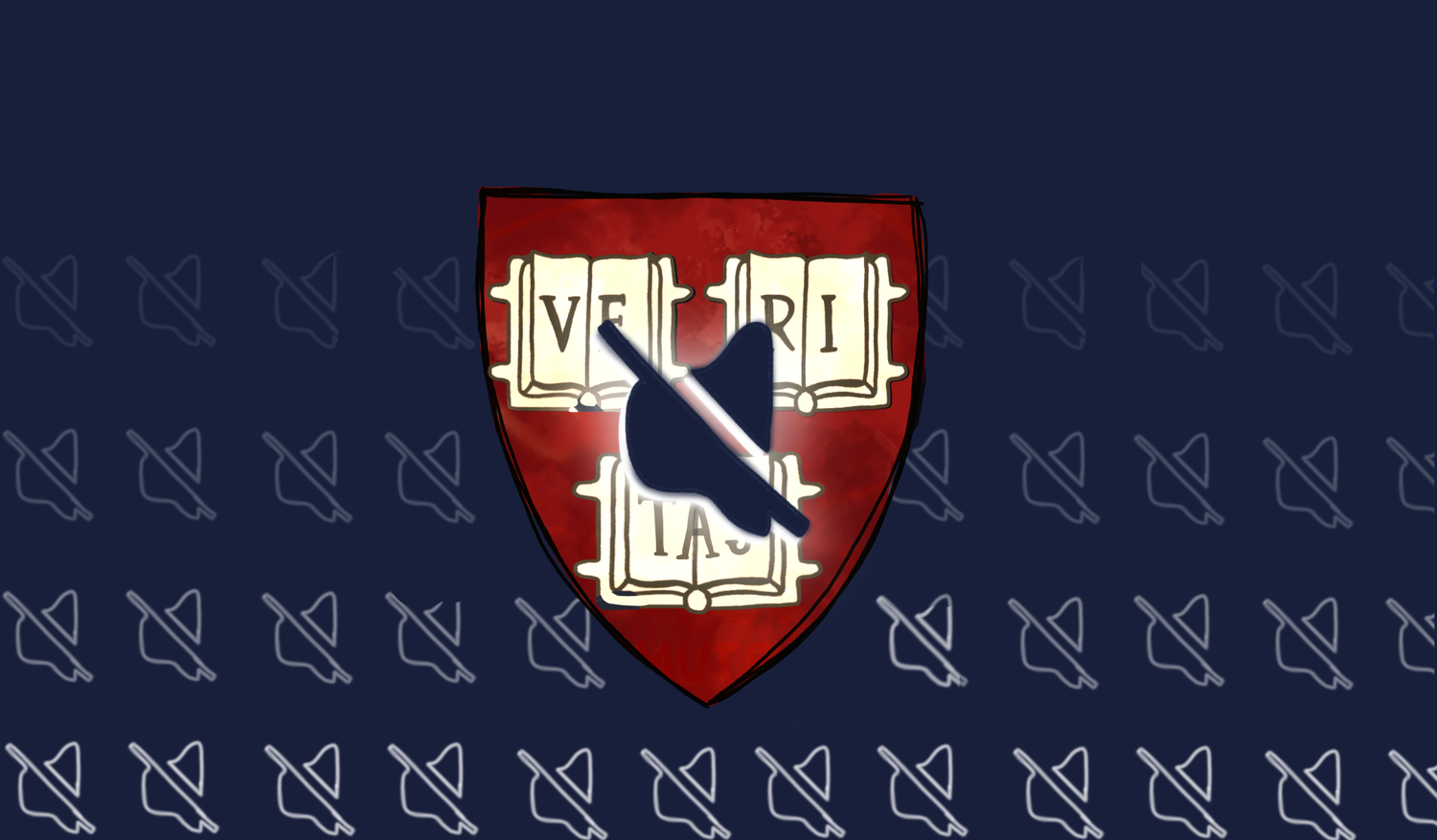
This year at Harvard has been, remarkably, quiet.
In 2024 and the aftermath of October 7, students occupied Harvard Yard in a pro-Palestine encampment, staged study-ins at Harvard libraries, and walked out of the University’s Commencement ceremony. In the first half of 2025, Trump took office, froze over $2 billion in Harvard’s federal funding, and attempted to revoke its authorization to enroll international students — the debate over Harvard’s response prompted rallies and petitions.
Yet in the past academic year, crises have made more noise in the headlines than on our campus, as students have largely gone about their lives as normal.
That’s not to say the year passed without disruption. We’ve witnessed the University attempt to navigate a new financial terrain through layoffs, restructuring, and even outsourcing to McKinsey. The Harvard Graduate Students Union-United Auto Workers went on strike over wages, arbitration for harassment and discrimination cases, and protections for non-citizen workers. We’ve made national news — again and again — now for our grading policies. And Harvard’s entanglement with Epstein has proven far deeper and more troubling than anyone had let on.
But imagine telling someone on campus two years ago — back when protests roiled Harvard Yard — that the United States would launch an ad-hoc war on Iran, yet the reaction on campus would be virtually nonexistent. They simply wouldn’t believe you.
A Desensitized Student Body
Simply put, given everything that has unfolded this year, the undergraduate student body is not as angry as it used to be. Or at least not outwardly.
This year, we learned that former Harvard President Lawrence H. Summers was even friendlier with convicted sex offender Jeffery E. Epstein than previously known. Epstein was revealed to be Summers’s self-described “wing man” and advised him on a relationship with a woman whom Summers referred to as a mentee.
However, Summers wasn’t the only Harvard affiliate shown to have yet closer ties to Epstein. The long list of affiliates connected to Epstein made clear how deeply tied he was to Harvard — and a fundamental issue: Harvard’s insufficient scrutiny.
Mathematics professor Martin Nowak continued to spend time with Epstein up until his arrest. Former Harvard Hillel leaders sought donations from him. Hasty Pudding Institute Chair Andrew L. Farkas ’82, who had previously claimed that Epstein was merely his business partner, was in reality a close personal friend of his. Billionaire Harvard donor Leslie H. Wexner was named a co-conspirator of Epstein in an internal FBI document.
In light of these connections, we’ve called for a reckoning around Harvard’s place amongst elites — starting with our donor policy. Yet despite the depth of Harvard’s entanglement with one of history’s most notorious pedophiles coming to light this year, the reaction on campus has been mild at most.
Students of Hasty Pudding Theatricals and the Harvard Kennedy School each organized petitions to remove the name of their respective Epstein associate-cum-building namesake. Summers returned to a lecture hall as if the news were merely a speedbump. The most vocal protest appears to have been students temporarily covering the John Harvard statue with printouts displaying Epstein, Summers, and evidence of their communications.
We should expect more.
Last year, when attacks from the federal government first started rolling in, campus united: the Harvard Students for Freedom formed, building a defiant protest coalition against capitulation to federal demands.
In March, the Trump administration sued — accusing the University of violating Title VI of the Civil Rights Act by mishandling antisemitism — and yet this time, the campus was unfazed, seeing less of the rallies and flyering that had defined the previous year.
As a community, we’ve grown accustomed to a new normal in which attacks from the federal government are routine. A year and a half into the second Trump administration, we’ve come to expect the unexpected — and thus are desensitized when it hits our headlines.
It’s not just about federal attacks, either. Campus has become eerily quiet in response to current events, whether that news threatens Harvard, the nation, or the world. Perhaps overwhelmed, the student body has turned inwards, mobilizing against the A-minus instead of nobler causes.
The same goes for Harvard’s treatment of its workers. Though undergraduates have shown some solidarity with the HGSU strike, engagement appears lower than in the past. Last time the graduate student union struck, Harvard undergraduates walked out on day two.
This time, it seems, barely two show up at the picket line.
A Quiet Administration
This newfound silence in the student body has been paralleled by a shift in our administration’s posture. Last year, University President Alan M. Garber ’76 was loud and proud in his stance against the Trump administration. This year, in contrast, has been marked by shifts in University governance — moves which are hard to definitively identify as unwitting capitulation or purposeful change.
Over the summer, the College closed its centers for women and LGBTQ+ students and scrubbed the language of diversity, equity, and inclusion from its dictionary — with the notable exception of “viewpoint diversity.” Office staffers were quietly consolidated into the new Harvard Foundation.
Then, in the fall, Harvard instructed alumni interviewers not to mention an applicant’s race, ethnicity, or national origin in their write-ups — preventing interviewers from painting a full picture of applicants and disadvantaging students whose marginalized identities are core to their experience.
The University also quietly shuttered its Undergraduate Minority Recruitment Program, which had sent student coordinators to visit underrepresented schools and simply encouraged high-achieving students to apply without having a hand in admissions decisions. That the University would effectively shut it down as if it did offer such a boost, counterfactually practicing affirmative action, proves yet again that the University’s fear of external attacks beats out its commitment to accessibility and equity.
Despite hopes a year ago that Harvard would be a standard-bearer of the nation’s resistance against the Trump administration, we have instead witnessed publicized legal battles paired with quiet capitulation to the federal government’s ideals.
Cutting ties with DEI was not the only topic the Harvard administration was silent on this year. Even after federal agents lied their way into a residence hall of a peer university, Harvard has neglected to adequately prepare its campus for the looming threat of Immigration and Customs Enforcement.
Once again, the administration has failed to forthrightly communicate to its student body — and why would it, if no one will make that failure a problem?
In contrast, the College has drawn remarkable attention to its new cap on A grades at roughly 20 percent to curb grade inflation and its efforts to support viewpoint diversity — appealing policies for a conservative audience.
The Harvard vs. Trump saga has become little more than political theater — and students have settled into their seats.
One Step Forward and Three Steps Back for Speech
In many ways, speech culture on campus feels much more open today than a year or two ago.
From the beginning of the year, when Harvard College Dean David J. Deming vowed to protect conservative undergraduates after the murder of Charlie Kirk, Harvard redoubled its commitment to uplifting viewpoint diversity and intellectual vitality.
The Faculty of Arts and Sciences reformed its policy to allow affiliates to mount publicly visible signs in private campus spaces, such as office windows — a move in the right direction after two professors were ordered to take down a Black Lives Matter sign from their windows. Further, the College refrained from punishing the Harvard Salient after it published rhetoric echoing Adolf Hitler. Although the Salient’s actions were deplorable, the University’s move set the right precedent that speech in student publications must be protected.
Yet while speech is flowing more freely, the speech spoken also feels, on the whole, much safer than before.
The Harvard College Debate Union withdrew a motion on Jewish emancipation after it faced backlash, denying students the opportunity to learn about a historical topic.
Coupled with the lack of protests and organizing among undergraduates this year, this incident reveals a shift towards self-censorship on campus despite the administration’s supposed attempts to foster free speech.
In Need of Noise
All in all, it was a relatively quiet year. Not every year needs an encampment — but given the circumstances, a healthy university would experience some commotion.
Looking to the future, we must remember that free speech is not just the ability to disagree with a grading policy. If we are committed to an environment of free exchange of ideas, students and faculty must also be unafraid to take a stand on the hard, controversial issues — especially when the federal government desires exactly the opposite from us.
We should care about the Epstein files, about the war in Iran, and about the federal government continuing to threaten our University.
Failing to care is to let go of democracy — to surrender the civic life that a place like Harvard ought to model.
Unfortunately for everyone, there’s little to stop Harvard students from sinking into the “Bermuda Triangle” of high-paying, prestigious jobs of dubious social value. Why care about democratic rights, let alone a university, when money waits at the door?
Harvard must possess more than a culture of free speech and idle chat — it needs students who meet the moment. Hopefully, a year from now, the 2026-2027 academic year rings louder in our ears.
This staff editorial solely represents the majority view of The Crimson Editorial Board. It is the product of discussions at regular Editorial Board meetings. In order to ensure the impartiality of our journalism, Crimson editors who choose to opine and vote at these meetings are not involved in the reporting of articles on similar topics.
Have a suggestion, question, or concern for The Crimson Editorial Board? Click here.
Want to keep up with breaking news? Subscribe to our email newsletter
Have a tip for The Crimson? Share it confidentially