Verveine Café and Bakery’s Monica Glass on Gluten-Freedom
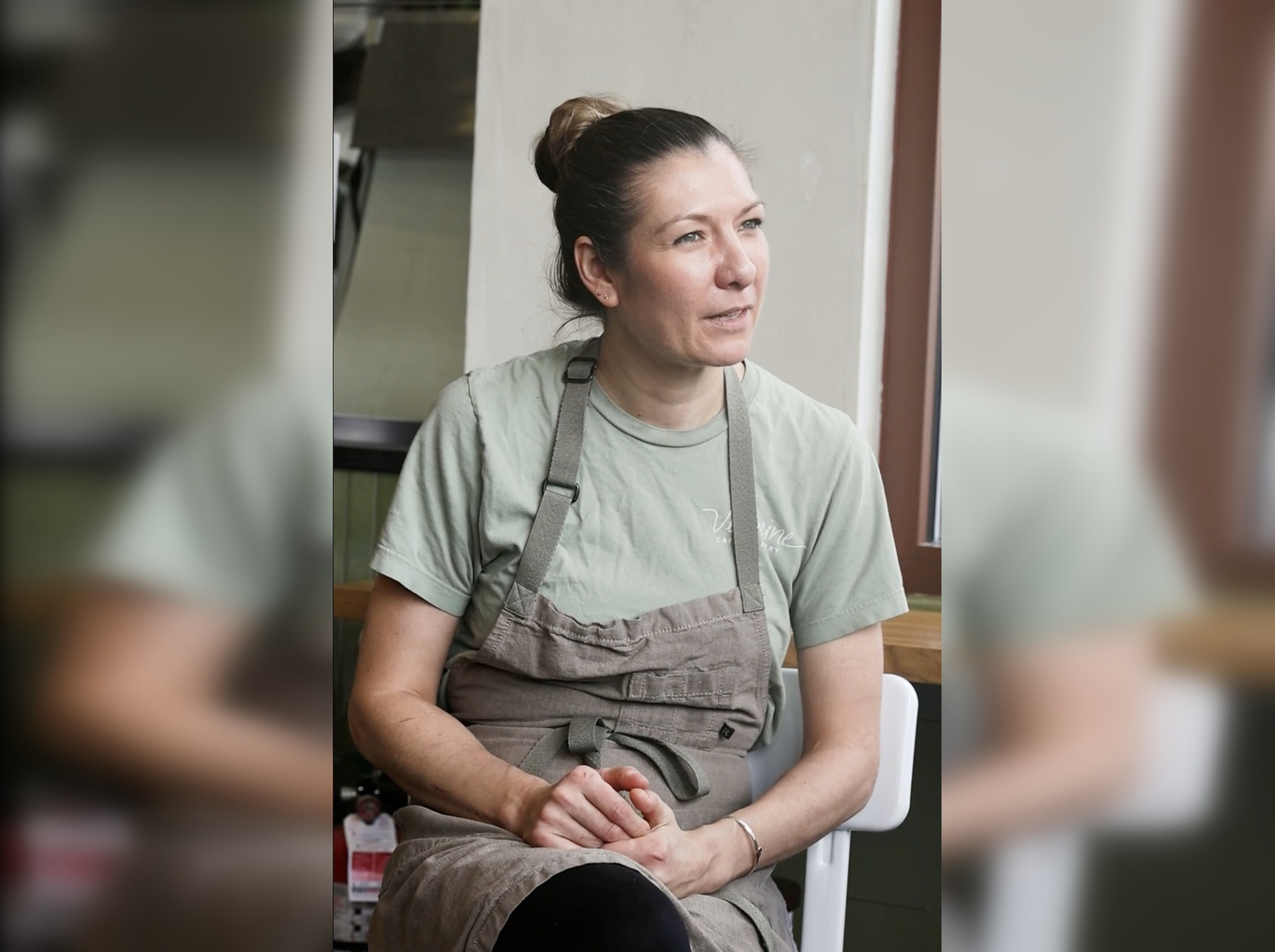
When The Crimson sat down with chef and café-owner Monica Glass, Verveine Café and Bakery was already deep into another bustling morning. As Glass stepped out of the kitchen, the operation continued churning through the glass behind her as bakers shaped dough into an array of globally-inspired baked goods: piña colada galettes, red velvet rose cookies, and vibrant ube brownies that have become a near-permanent fixture on Verveine’s menu.
Verveine is a small, inviting space with 24 prized seats, and at the heart of it all is a tantalizing display case of those baked goods — all gluten-free, though you wouldn’t know it if no one told you. The ethos is simple and heartfelt:
“I create a community or space where people can dine together safely and feel included at the table,” Glass said in an interview with The Crimson.
Glass’ philosophy is the product of a very specific career arc, one that she initially resisted defining herself by.
Before opening the café, Glass built a long, storied career in pastry, working her way through some of the nation’s best kitchens, including Gotham Bar and Grill, Le Bernadin, and Clio (now called Uni). She was drawn to the discipline not by a sweet tooth — she leans savory — but by pastry’s particular blend of science and artistry.
“I like to know the reason why things work the way they do,” Glass said. “So the science aspect of pastry really enlightened my brain, and then the artistry of it — I like to work with my hands to make things, to make pretty things.”
Glass’ career took an unexpected turn in 2009, when she was diagnosed with celiac disease.
“I thought that the viability of my career was over, because I was working with the one ingredient that was making me sick every day,” Glass said.
For Glass, her diagnosis was the beginning of a gradual acclimation. She began experimenting with alternative flours and recipes but continued working in conventional kitchens serving wheat pastries and desserts.
“Diet-wise, I ate gluten-free entirely, but I didn’t want that to define me as a chef,” Glass said.
She could still develop those recipes without tasting them herself, relying on what she calls her “mental mouth” — an internal register of flavors built over years of professional tasting. Glass wanted to do everything at once and, for some time, she did.
“You know how you go through stages of grief? That acceptance stage took a while,” Glass said.
Around 2012, while heading the pastry program at Clio, Glass realized that her technical background wasn’t lost in translation to a gluten-free career. As her confidence in an allergen-friendly future grew, so did an innate impulse to innovate and build something of her own.
Glass fondly recalled an early entrepreneurial streak: running a personal cleaning business and founding a babysitting operation, hiring out her friends to families in the neighborhood. As an “entrepreneur at heart,” she imagined that her next venture could be something much more personal.
“It was always in the back of my mind that I wanted to create a space like this where everybody could dine together, because I had felt so excluded, so isolated trying to eat during that period of my life that I didn’t want anybody else to feel that way,” Glass said.
That conviction followed her into her next chapter. Glass moved away from Boston to work for a high-end catering company in Philadelphia, but she and restaurateur Ken Oringer — whom she had worked with at Clio — stayed in conversation after she left, circling the idea of building something together. When they did, it held personal significance for both of them: Verveine is named for Oringer’s daughter, who was also diagnosed with celiac.
“I had always wanted to open something gluten-free, and then that’s where [Oringer] was like, ‘All right, Moni, let’s do this gluten-free thing,’” said Glass.
That same drive shows up in WLDFLR, the flour brand Glass developed alongside Verveine. Unsatisfied with any of the commercial gluten-free flours on the market, she built her own. The process of pinning down specific textures across different applications was highly iterative, and the laundry list of proteins and starches calibrated to mimic the behavior of all-purpose flour are a testament to her persistence. However, some of her proudest offerings, like her Danish dough and puff pastry, still demanded months of development independent from the flour.
“It’s not all-purpose, but it is multi-purpose,” Glass said.
The manufacturing is still small-scale, and Glass hauls her 50-pound flour bags to and from her own basement to the café, where they function as stanchions cordoning the vitrine. The operation is larger than her own kitchen, where it started — but not yet wholesale.
For now, though, the café is the focal point. Verveine has carved out a distinct identity as a community space with a menu touched by a wide array of cultural influences — French, Italian, and Japanese, to name a few — and a kitchen that’s visible, open, and always moving. It’s a site where gluten-free is progressing from a concession to a foundation; a foundation Glass is building intently, recipe by recipe.
Want to keep up with breaking news? Subscribe to our email newsletter
Have a tip for The Crimson? Share it confidentially