Two-Thirds of Graduating Seniors Expressed Opposing Views on Controversial Topics, Deming Says
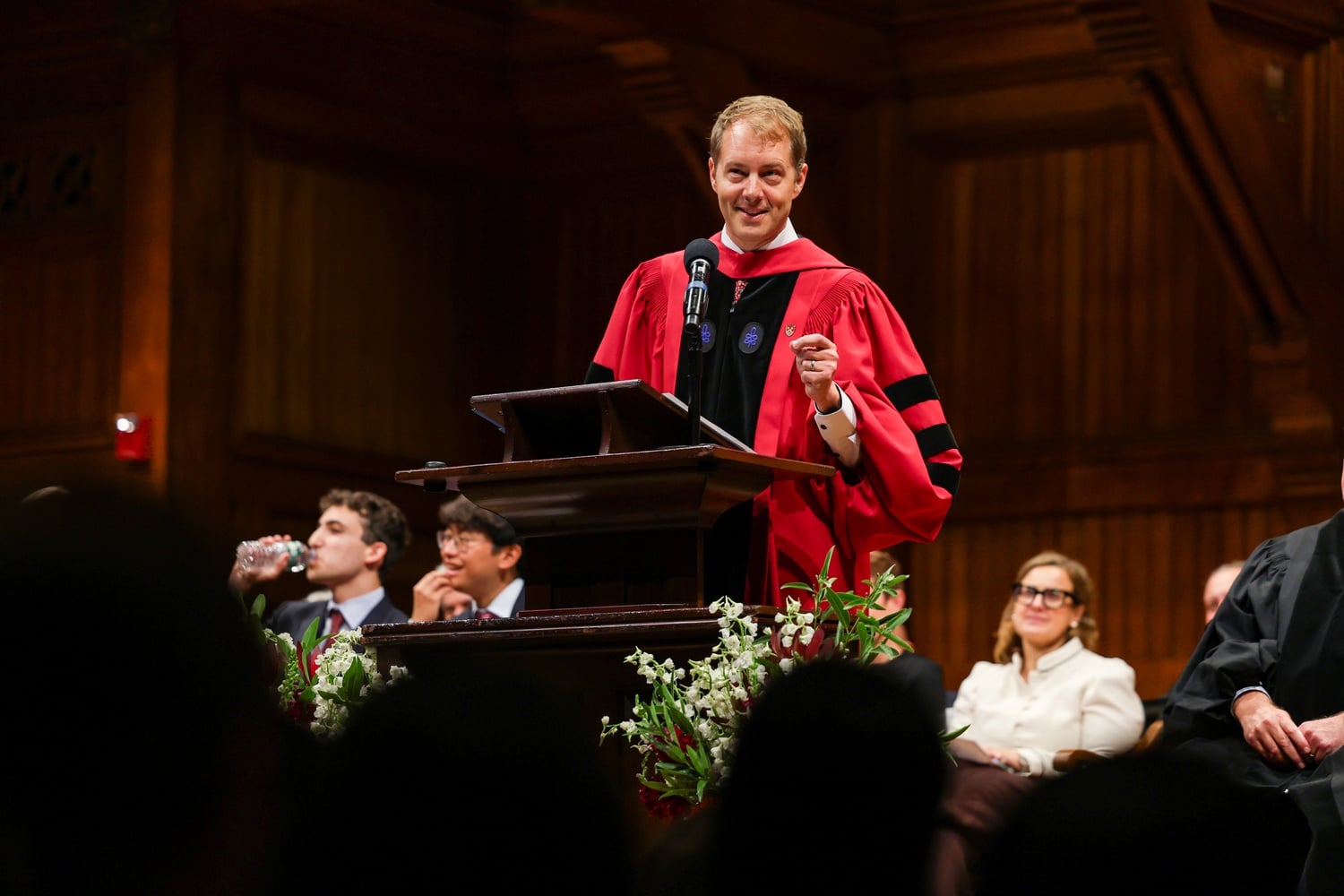
Two-thirds of Harvard’s graduating seniors expressed opposing views on controversial topics when they felt it was important to do so, Harvard College Dean David J. Deming said Saturday — a more than 20 percentage point jump from the Class of 2023.
Deming cited the statistic, pulled from the University’s internal survey of the graduating class, to argue during a Family Weekend address that Harvard had made “real progress” in facilitating open discourse. Deming said 95 percent of graduating seniors responded to the survey, which is conducted by the Office of Institutional Research and Analytics annually in May.
The senior survey typically asks a series of questions about freedom of expression. Deming only cited one subquestion — students who have expressed opposing views on controversial topics when they “felt it was important to do so” — and said the share of students climbed from 44 percent in 2023 to 67 percent in 2026.
Though the survey results are not widely distributed, the University has historically referenced the findings to gauge the state of free speech on campus. Then-dean Rakesh Khurana expressed frustration publicly about the anemic speech environment indicated by the 2023 survey results, and a January 2025 report on free speech by the Classroom Social Compact Committee cited the 2024 findings.
“I want to be clear: I’m not declaring victory, not until these numbers are at 100, because every student should feel free to express themselves and to explore contested ideas at Harvard,” Deming said of the 2026 results. “But we have been working hard on these issues, and we’ve made real progress.”
Deming attributed the improvement to a “variety of efforts” undertaken in recent years, citing orientation modules on constructive dialogue, limited access to screens in the classroom, and the adoption of the Chatham House Rule, a non-attribution policy for in-class discussions.
Deming’s remarks came ahead of a faculty panel in Sanders Theatre on “The Future of Academics at Harvard,” moderated by Dean of Undergraduate Education Amanda Claybaugh. The panel was a centerpiece of Family Weekend, an annual tradition that brings relatives of freshmen and juniors to campus for the chance to experience academic and social life firsthand.
Get The Crimson in your inbox.
The faculty discussion focused heavily on the College’s controversial policy to cap A grades at 20 percent of undergraduate enrollment, with flexibility for up to four additional A’s. During the panel, Psychology professor Josh D. Greene ’96 defended the grade cap as necessary to restore the distinction of an A grade while preserving as much faculty autonomy as possible.
“A minus is about mastery, and an A is going above and beyond,” Greene said. “You can’t have two-thirds of the class exhibiting extraordinary distinction.”
Deming said the senior survey proved students were “deeply engaged” in their academics. Eighty-eight percent of graduating seniors said they felt at least one Harvard faculty member was invested in their success, Deming cited, and 69 percent said they would stay in touch with at least one faculty member after graduating.
“We are fighting to win the increasingly intense battle for your students’ time and attention by making the classroom a place where they want to be fully engaged and where they feel their intellectual efforts are richly awarded,” Deming said. “I’m proud to say that our efforts are very fruitful.”
Deming also restated a condensed version of his September convocation address, arguing that artificial intelligence would democratize expertise and require higher education to differentiate itself through an emphasis on communal learning.
Deming said the University was bridging that transition by facilitating opportunities for social connection, pointing to extended hours in Annenberg Hall and a funded program to expand faculty and staff presence in dining halls.
He also appeared to reference a divisive five-day in-office mandate for staff implemented this fall, saying he asked College affiliates to “take meetings in-person rather than online” to prevent digital distractions.
“When expertise is increasingly abundant, talented students like yours will come to Harvard to learn the skills, the habits of mind, and the virtues that can’t be learned from behind the computer screen,” Deming told parents.
“Even in a world where expertise is abundant, Harvard is still unique in its ability to bring the most talented students in the world together to engage deeply with teachers, mentors, and with each other,” he added. “I believe we should lean into this core strength.”
Want to keep up with breaking news? Subscribe to our email newsletter
Have a tip for The Crimson? Share it confidentially